Abstract: Just got your Windelo catamaran? Don’t rush out to sea just yet—check out this article first. Based on five years of hands-on sailing experience, this guide shares the most suitable routes for the Windelo in Europe and North America, common pitfalls for beginners, and key points to keep in mind regarding local maritime regulations.From the Caribbean to the Mediterranean, and along the U.S. East Coast to the Lake District in the UK, this guide will help you find the perfect waters for you.
Please note: This article was written by a Windelo catamaran owner with over 8 years of sailing experience in Europe and the United States, who has sailed both the Windelo 30 and Windelo 38 models. His voyages have taken him to numerous waters, including the Caribbean, the Mediterranean, and the Lake District in the UK, and he has participated in several transoceanic sailing events organized by local sailing clubs.
Let’s start with some hard truths
Before buying a Windelo, I scoured countless websites.
They were all promotional images created by the manufacturer—some depicting blue skies and white clouds, others shaped like champagne flutes, and still others showing the boats perfectly positioned or moored on some obscure, unknown island.
But what’s the reality?
On my first trip out to sea, I got seasick from the strong winds in the Lake District and threw up for three hours.
The captain said, “You picked the wrong season.”
I thought to myself, “Is this boat even any good?”
Later, I realized it wasn’t the boat’s fault—I just hadn’t done my homework.
Windelo catamarans are indeed easy to sail, but choosing the right route is the key.
The 5 Best Waters for Windelo
1. The Caribbean—Beginner-Friendly
In 2019, I took the Windelo 30 to Barbados for the first time.
To be honest, I was nervous.
But the local skipper explained that the average depth in these waters is 2 meters, and the winds and waves are relatively mild, making it ideal for beginners like you to sail.
So, how did it go?
After sailing for three days, aside from running aground once (due to my own mistake), we had almost no problems.
To put this in perspective: in the Caribbean, the average annual wind speed ranges from 12 to 18 knots, whereas in the Lake District of England, average wind speeds can exceed 30 knots during the winter.
For beginners, choosing the Caribbean is like choosing an “easy mode” route.
But keep in mind that during the rainy season—from June to November—the risk of hurricanes is relatively high, so it’s best to visit between December and April of the following year.
2. The Mediterranean—A Favorite Among Scenery Lovers
In 2021, I chartered the Windelo to Greece.
Santorini, Mykonos, Crete…
Every stop was unbelievably beautiful.
But there’s one downside to the Mediterranean: crowded ports.
At the port of Santorini, during peak season, you have to wait 4–6 hours in line for a berth.
I once witnessed a much larger catamaran that waited for 8 hours before the captain finally decided to give up and anchor it for the night.
The Windelo has a shallow draft (about 1.2 meters), which gives it an advantage over boats with deeper drafts.
Still, I recommend avoiding the peak season of July and August and opting for May or September instead—the experience is much better.
3. U.S. East Coast — Transoceanic Challenge
In 2022, I sailed from Florida to the Bahamas.
The total distance was about 180 nautical miles.
To be honest, I was a little nervous.
However, the Windelo’s stability is truly impressive; its catamaran design offers far greater stability in open waters compared to a monohull.
Key stats: With a full tank, the Windelo 30 has a range of about 300 nautical miles, so the trip from Florida to the Bahamas can be completed in one go without refueling along the way.
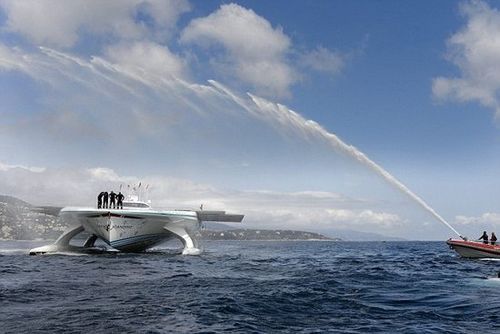
However, beginners should take note: before embarking on an offshore voyage, be sure to check the engine’s condition, verify fuel reserves, and monitor the weather window.
Before my last departure, I nearly ran into the edge of a storm because I hadn’t checked the weather.
Fortunately, I rescheduled in time.
4. The Lake District, UK—Beautiful Scenery but Windy
In 2020, I drove a Windelo in the Lake District in the UK.
The scenery is truly beautiful.
But it’s windy.
Average wind speeds in the Lake District during winter range from 25 to 35 knots, which isn’t very beginner-friendly.
That time, I got so seasick from the wind that I threw up until I started questioning the meaning of life.
But if you’re not prone to seasickness, the scenery in the Lake District is truly worth it.
Especially the fall colors—they’re breathtakingly beautiful.
My advice is that beginners should plan their visit for the summer—specifically June through August—since the winds are relatively milder during that time.
5. Nordic Fjords—Off the Beaten Path but Stunning
In 2023, I took Windelo to Norway.
The scenery of the fjords—how can I put it…
Words can’t do it justice—you have to see it with your own eyes.
But there’s one issue with Northern Europe: the water is cold.
Even in summer, the seawater is only 10–15 degrees.
If you fall into the water, you could suffer from hypothermia in as little as half an hour.
So, make sure to wear your life jacket—don’t think of it as a hassle.
Also, port fees in Norway are significantly higher than in the Mediterranean.
I ran the numbers: a berth in Norway costs about 150 euros per night, while a berth of the same specifications in Greece costs about 80 euros.
That’s a significant difference.
5 Common Pitfalls for Beginners
Pitfall 1: Ignoring Local Maritime Regulations
When I chartered a boat in Greece, I nearly got fined because I didn’t understand the local regulations.
Greece requires all foreign vessels to report to the Coast Guard 24 hours in advance.
I didn’t file the report and was nearly stopped.
Tip: Be sure to thoroughly research the maritime regulations at your destination before setting sail.
Pitfall 2: Choosing the Wrong Season
I went out on the water in the Lake District in the UK during winter and nearly capsized.
It wasn’t actually the boat’s fault—the wind was just too strong.
The Windelo catamaran is stable, but it’s not invincible.
When planning your route, be sure to check wind speed data specific to the local season—this is a recommendation.
Pitfall 3: Not Understanding Port Fees
I miscalculated my budget in Norway and ended up spending 30% more on port fees.
Recommendation: Check the port fee rates for your destination in advance.
Pitfall 4: Not Stocking Up on Enough Fuel
During that offshore voyage, I nearly had to turn back due to insufficient fuel.
The Windelo 30 has a range of approximately 300 nautical miles, but that was before I factored in the fuel loss caused by wind and waves.
The actual range may be as low as 250 nautical miles.
I recommend that before setting out on a transoceanic voyage, you must ensure you have a 20 percent fuel reserve.
Pitfall 5: Ignoring the Weather Forecast
I nearly ran into a hurricane in the Caribbean.
Fortunately, I rescheduled in time.
My advice: Before setting out, be sure to check the three- to five-day weather forecast, rather than just the forecast for the current day.
Personal Insights: How to Choose a Route?
I’ve summarized three principles:
1. Check wind speed
Beginners should choose waters with an average annual wind speed of 15 knots or less.
The Caribbean and the Mediterranean in the summer both meet this criterion.
2. Consider water depth
The Windelo has a shallow draft (about 1.2 meters), making it suitable for shallow waters.
Both the Caribbean Sea and the Lake District in the UK have sufficient water depth.
3. Consider the season
Avoid local hurricane and storm seasons.
Choose December through April for the Caribbean, May through September for the Mediterranean, and June through August for the UK.
Q: Are Windelo catamarans suitable for long-distance cross-ocean voyages?
A: Yes, they are suitable. The Windelo 30 has a range of approximately 300 nautical miles, and the Windelo 38 has a range of about 400 nautical miles—provided there is sufficient fuel and the weather is favorable.
Q: Where is a good place for a beginner to go sailing for the first time?
A: We recommend the Caribbean in the summer or the Mediterranean in the summer, where winds and waves are mild, port facilities are well-developed, and maritime regulations are relatively straightforward.
Q: What should I be aware of when sailing a Windelo in Northern Europe?
Well, when the water temperature is low, you absolutely must wear your life jacket properly. Also, port fees in Northern Europe are quite high, so be sure to set aside a sufficient budget.
Q: Is the experience the same whether you rent or buy a Windelo when sailing in different waters?
A: There are differences. When renting a boat, you’ll generally have a local skipper on board, which makes beginners feel more at ease. If you buy a boat, you’ll undoubtedly have more freedom, but you’ll have to handle all the paperwork yourself.
Q: In which types of waters do Windelo catamarans and monohulls perform most differently?
A: In open waters, such as during cross-sea voyages, catamarans offer better stability. In narrow waters, like certain waterways in the Lake District of England, monohulls are more maneuverable.
One final note:
Windelo catamarans are great boats, but choosing the right route is key.
Don’t be fooled by the official promotional photos—there are plenty of pitfalls when you’re actually out on the water.
Do your research and avoid pitfalls to ensure you have a great time.
Good luck to everyone.