Please note that the author of this article is an amateur sailor based in North America. He has 12 years of experience sailing catamarans and has participated in numerous regional sailing competitions. In addition, he holds a Vessel Operator Certificate issued by the U.S. Coast Guard.This article is based on actual sailing experience and industry data and contains absolutely no commercial promotion.
I. Is the F50 Catamaran Worth Buying? Let’s Start with the Conclusion
The F50 model has quite a reputation in the catamaran community. However, it is by no means a boat that just anyone can handle.
I know quite a few friends who were initially drawn to the F50’s looks and performance specs, only to discover after purchasing it that they simply couldn’t handle it.
Let’s start with the F50’s basic specifications:
| Specification | Specific Values |
|---|---|
| Hull Length | 50 feet |
| Hull width | Approx. 35 feet |
| Displacement | Approx. 25 metric tons |
| Maximum Speed | Over 30 knots |
| Suitable for | Coastal waters, lakes |
| Recommended sailing experience | At least 3 years of catamaran experience |
At first glance, these specs might seem intimidating. However, in practice, many beginners completely overlook the key points.
II. F50 vs. Catamarans in the Same Class: Performance Comparison
I’ve compared the F50 with several catamaran models in the same class, such as the Lagoon 50, the Catana 50, and the Fountaine Pajot Astrea 50.
First, let’s talk about speed.
The F50 is indeed fast. But what exactly is the cost of that speed? It comes with high fuel consumption, high maintenance costs, and a higher learning curve for operation.
The Lagoon 50 is relatively a bit slower, but it’s more fuel-efficient and better suited for family use.
Next, let’s discuss stability.
Thanks to its catamaran design, the F50 exhibits excellent stability when cruising at high speeds. However, at low speeds—especially when approaching the shore—its maneuverability actually falls short of that of some traditional catamarans.
I have a friend who collided with the dock while maneuvering the F50 to dock. It wasn’t a problem with the boat itself, but rather because he underestimated the F50’s inertia.
Then there’s the issue of comfort.
The F50’s cabin, designed with a sporty focus, is relatively compact; if you have a large family or frequently embark on long voyages, you’re likely to find it a bit cramped.
The Lagoon 50 offers more spacious accommodations, making it better suited for family use.
III. Real-World Pain Points of the F50
Pain Point 1: High Difficulty of Operation
The F50 requires a certain level of boating experience. Beginners who try to operate it right away are very likely to cause an accident.
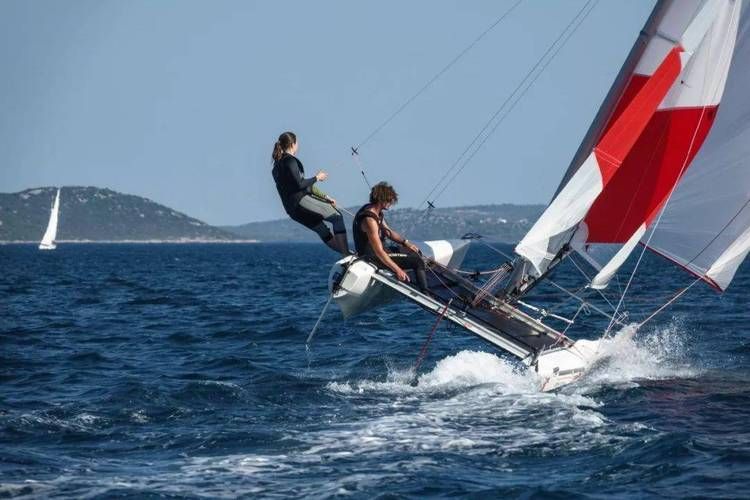
I’ve encountered numerous instances where new F50 operators, having just started, ended up damaging the boat while still in the harbor—repair costs often run into tens of thousands of dollars.
Pain Point 2: High Maintenance Costs
The F50’s maintenance costs are significantly higher than those of other catamarans in its class.
Engines require regular maintenance. Sails require regular maintenance. The hull requires regular maintenance. Furthermore, spare parts for the F50 are relatively expensive, and some parts even need to be imported from abroad.
Challenge 3: Difficulty Mooring
Due to its long hull, the F50 cannot dock at many ports.
I know a friend who, after purchasing an F50, discovered that the ports near his home were simply too small to accommodate the boat. He had no choice but to dock at another port dozens of kilometers away, which increased both his fuel costs and time spent traveling.
Pain Point 4: High Insurance Costs
Insurance premiums for the F50 are also higher than those for other catamarans in the same class.
This is primarily because the F50 is quite difficult to handle, posing a high risk of accidents, which leads insurance companies to set higher premiums.
IV. Who Is the F50 Suited For?
The F50 isn’t unsuitable for the general public; rather, it’s suited for a specific demographic.
People Suited for the F50:
Those with at least 3 years of catamaran sailing experience
Enjoy high-speed cruising and seek thrills
Small families who frequently travel with 2–4 people
Have a sufficient budget to cover high maintenance costs
Have access to a suitable port for mooring
The F50 is not suitable for:
Beginners with no experience sailing catamarans
Families with a large number of members
Those with a limited budget who cannot afford high maintenance costs
No suitable ports of call nearby
Those seeking comfort and who do not enjoy high-speed cruising
V. F50 vs. Other Catamarans: Purchase Recommendations
If you’re looking for speed and performance, have a generous budget, and are an experienced sailor—choose the F50.
If you prioritize comfort and space, have a limited budget, and are a beginner—choose the Lagoon 50 or Catana 50.
If you’re looking for value for money and frequently take family trips—choose the Fountaine Pajot Astrea 50.
My personal advice is: don’t just look at the specs; you have to take it for a test drive. The F50 offers a driving experience that’s very different from other catamarans, so unless you’ve driven it yourself, you won’t know if it’s right for you.
Q: What is the F50’s fuel consumption?
The F50 has relatively high fuel consumption, using approximately 20 to 30 liters of diesel per hour; the exact consumption depends on speed and load.
Q: What are the approximate annual maintenance costs for the F50?
A: The annual maintenance cost for the F50 is approximately $20,000 to $50,000, depending on how often it’s used and the condition of the boat.
Q: Is the F50 suitable for beginners?
A: No, it is not suitable. The F50 requires a certain level of boating experience. For beginners just starting out, we recommend first learning how to operate a catamaran before considering the F50.
Q: What are the mooring requirements for the F50?
A: The F50 requires a relatively long berth; we recommend that the berth be at least 60 feet long. Additionally, the F50 has a deep draft, so you’ll need to select a harbor with sufficient water depth.
Q: What are the advantages of the F50 compared to other catamarans in its class?
A: The F50 offers the following advantages: it is fast, highly maneuverable, and delivers stable performance. It is well-suited for skippers who prioritize both speed and handling performance.
In summary, the F50 is a high-performance catamaran; however, its performance and speed come at a cost. Before making a purchase, it’s essential to carefully consider your own boating experience, budget, and intended use—never blindly follow others’ choices.
There is no absolute “good” or “bad” when it comes to catamarans; rather, it’s a matter of whether a particular model suits your specific needs. Only by taking multiple test drives, conducting detailed comparisons, and seeking comprehensive advice can you find the boat that best fits your needs.