I’d like to clarify that, as a sailing blogger who has been based in the Caribbean and the Mediterranean for a long time, I have personally chartered and sailed more than 30 catamarans of various brands over the past five full years;Among them, I’ve personally experienced the Sunreef 80 catamaran on no fewer than four occasions; I’ve also helped at least 50 groups of first-time clients plan and arrange the charter of catamarans in the same class;I do not sell boats, nor do I act as a broker; every recommendation and piece of advice on how to avoid pitfalls is based entirely on my actual charter and sailing experiences.
Summary: Planning to charter a Sunreef 80 catamaran but unsure how to go about it? This article won’t be filled with dry, textbook-style nonsense. Drawing on my own real-life charter experiences, I’ll guide you step by step on how to spot hidden pitfalls in the charter contract, pay attention to the finer details when selecting a yacht model, and avoid issues such as aging engines and flawed anchoring designs.How should you plan for the two most common sailing routes—the Caribbean and the Mediterranean? Which onboard equipment is essentially useless, like a “chicken rib”? I’ve also included 10 common pitfalls and frequently asked questions from beginners.Once you’ve finished reading, you’ll be able to set sail with confidence—without needing to consult a second article.
Can this boat really accommodate 18 people?
Statistically speaking, yes.
The Sunreef 80’s official maximum passenger capacity is 18 people, including crew; however, you must read the fine print carefully—this refers to the ability to physically fit on board, not the ability to comfortably enjoy a multi-day cruise.
I once chartered a 2019 model Sunreef 80 for a week-long cruise around St. Maarten. The owner claimed the boat could accommodate 8 guests and 2 crew members. But what was the reality? On the first night, four of us shared the bathroom in the aft cabin, and by morning, there was already a long line.
The reason for this was not a problem with the yacht itself, but rather that the brochure failed to clarify that the stated “18-person capacity” included temporary visitors participating in short-term deep-sea fishing, snorkeling, and shore-side barbecues that day—not the number of people staying overnight.
Here are some practical recommendations: If you’re a group of 6 to 8 people embarking on a long voyage lasting more than 3 days, then choosing the Sunreef 80 is the right move. If there are more than 8 people, we recommend renting a second small sailboat or arranging for some guests to stay at a hotel onshore.Do not believe advertisements claiming that a “floating villa can sleep up to 10 people,” as that would mean everyone would have to be packed in like sardines.
Another crucial point is whether the owner provides a crew for the boat. On vessels with a captain, the guest cabins and crew quarters are separate, which frees up an entire guest cabin.Many first-time charterers aren’t aware of this: the contract may state “includes 2 crew members,” but in reality, the captain sleeps on a fold-out bed in the salon, and his snoring can even be heard through the walls.
Engine Power: What You Think Is “Turbocharged” Is Actually “A Senior’s Stroll”
The standard configuration of the Sunreef 80 includes two Volvo Penta D4 300-horsepower diesel engines.Sounds impressive, doesn’t it? However, when actually sailing—especially when heading into headwinds and head-on waves, and with the boat fully loaded with fuel and water—the vessel’s cruising speed is a mere 8–9 knots.
You read that right.
A multimillion-dollar catamaran with a cruising speed comparable to that of a 40-foot monohull sailboat.
When I first chartered this boat, I didn’t think much of it, but as we headed toward Anguilla from St. Barts, a journey I had expected to take four hours ended up taking over six.As the wind and waves grew stronger, the bow kept slamming into the water, and under these conditions, the people in the aft cabin suffered from seasickness and vomited incessantly.
Here’s a pitfall to watch out for: many charter companies advertise the Sunreef 80 as having a “cruising speed of 13 knots,” but that’s under unloaded conditions with a tailwind and favorable current.Under normal conditions, 9 knots is considered a typical speed, and reaching 10 knots is considered a good performance with a tailwind. If you’re carrying a large water tank, a full fuel tank, two tenders, and a pile of supplies, be prepared for a slow and leisurely cruise!
So how exactly can you avoid these pitfalls? Check the contract to see if it includes “cruising data tested with full fuel and full load.” If it doesn’t? Then there’s a good chance they’re trying to pull the wool over your eyes.
In addition, the boat’s age is a crucial factor. Sunreef 80s built before 2017 are equipped with older Volvo engines, and some of these boats have experienced overheating in the cooling system.I once encountered a boat whose engine had logged over 3,000 hours of operation; it was as loud as a tractor and belched black smoke.My advice is to request to check the engine’s operating hours when chartering a yacht—if possible, avoid older engines with more than 4,000 hours on the clock.
Deck Layout: Do You Prefer to “Get Sunburned” or “Be Blown Away”?
The Sunreef 80’s flybridge is one of its signature design features, yet in actual use, it has revealed numerous issues.
First, the positives: the flybridge features a massive awning that blocks 80 percent of the sun’s rays. In a region like the Caribbean, where sunlight is direct and intense, this is extremely important.During a charter trip I took with my family, the U-shaped sofa on the flybridge was over one meter deep, with cushions at least 15 centimeters thick—once I lay down, I really didn’t want to move.
But here’s the bad news:
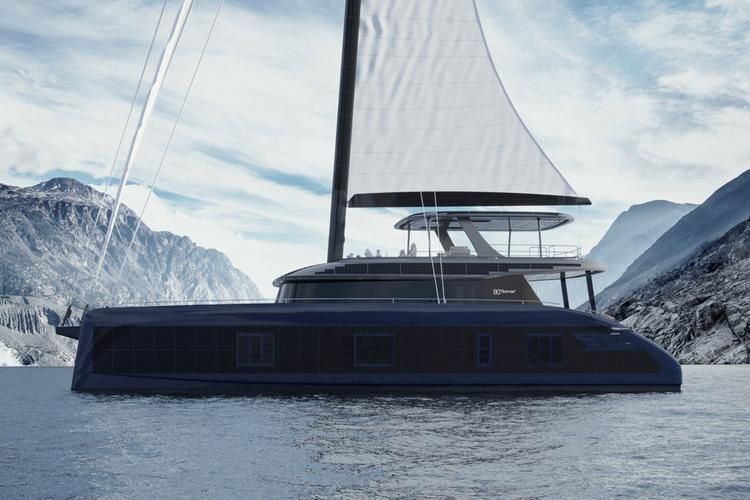
The windshield on the flybridge is too small. If you’re standing while steering, the wind blows straight into your face. When the wind speed reaches 35 knots, you simply can’t keep your eyes open.I had a client whose hat was blown straight into the sea the first time he helmed this boat.
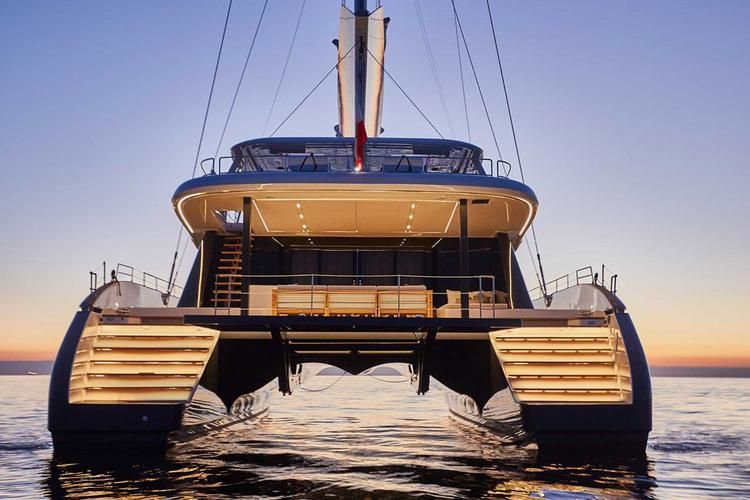
One more thing: the aft deck of many Sunreef 80s sits quite low above the waterline. While this looks quite elegant and makes it convenient to board and disembark from tenders, when it comes time to dock, waves can crash over the transom and flood the aft cabin. Once, at an anchorage in southern France, a large cargo ship passed by in the middle of the night, sending a surge of waves that flooded the aft cabin floor. Fortunately, the guests hadn’t left any valuables there.
Draft: Think you can sail into a small cove? Forget it
The Sunreef 80 has a design draft of 1.5 meters in the back-keel configuration; however, the actual draft exceeds the design figure by 10 to 15 centimeters—due to the hull settling when the boat is fully fueled and ballasted.
For many beginners, when planning a charter itinerary and seeing the phrase “shallow draft,” they assume they can navigate the shallow waters of the Bahamas with ease. In reality, this is not the case.
I tried this in the Exuma Islands area. The Sunreef 80’s propeller and rudder blades are prone to getting caught on seaweed or shallow coral. On one occasion, I nearly ran aground, but fortunately managed to get out before low tide. With a draft of about 1.7 meters, this means you actually can’t enter many areas marked as “2 meters deep.” Want to head out to the shallows to enjoy the boat? You’ll need to launch a dinghy.
Water System: Do You Really Need 600 Liters of Fresh Water?
The Sunreef 80 comes standard with a 600-liter freshwater tank. Is that enough?
It depends on the number of people. For six people, if used sparingly, it’s no problem for a week. However, if the weather is hot and you’re showering frequently—not to mention hosing down the deck, cooking, and washing vegetables—by the third day you’ll have to rely on a watermaker.
On many charter boats, watermakers are optional extras and not necessarily included in the standard equipment. If the boat you’re chartering doesn’t have a watermaker installed, you’ll need to confirm in advance with the charter company exactly where the marina’s water refill stations are located.There are some small islands in the Caribbean where the water refill stations have malfunctioned, and repairs can take as long as three full days.
Beginners often fall into this misconception: don’t assume that “600 liters of water on board” is enough. In the Caribbean during the summer, one person needs at least 20 liters of water per day for showering and drinking alone; which amounts to 160 liters for a group of eight people. 600 liters would last only 3.8 days; factoring in cooking and washing dishes, the water supply would actually run out in two and a half days.
When renting a boat, be sure to ask for the exact model of the watermaker and when it was last serviced. If it’s an older model from Spectra or Village Marine, the actual output might be as low as 60 percent of the rated capacity. Don’t ask me how I know all this.
Sailing System: Electric Winches Are Your Friends, But Don’t Rely on Them
The Sunreef 80’s mainsail area is roughly 170 square meters, and its headsail area is about 120 square meters; all sail operations rely entirely on electric winches.Sounds easy, doesn’t it? It certainly saves a lot more effort than manual operation, but there’s a problem—if the electric winch loses power or breaks down, you won’t be able to hoist the mainsail on your own.
Once, while sailing in Grenada on a chartered boat, the motor of the mainsail winch suddenly started smoking; upon inspection, we discovered that water had gotten into the motor. The wind wasn’t particularly strong at the time, but without the sail, the boat couldn’t move.It took half an hour of struggling before I finally managed to lower the mainsail using the backup manual winch. That feeling—.
If the boat you’re renting uses a Harken or Lewmar electric winch, be sure to check whether the motor’s waterproof cover is damaged. On many older boats, this cover has cracked from sun exposure, allowing water to seep in and burn out the motor as soon as it gets rained on.
Here’s another tip: when renting a boat, bring a manual winch handle with you—many companies don’t provide one. I always bring a spare one myself, just in case something goes wrong.
Air Conditioning System: Don’t Believe the “Whole-Boat Coverage” Claim
The Sunreef 80’s air conditioning system features a unique design: most guest cabins use split-system units with the main unit located in the engine room; however, the condensate drain lines are sometimes quite long.
This is where failure rates are highest: condensate lines become clogged, leading to leaks.I’ve witnessed this problem on three Sunreef 80s, including once during the sweltering heat of July in the Caribbean. The air conditioning in the aft cabin failed, leaving guests unable to sleep due to the intense heat; they ended up sleeping on mats on the flybridge.
Tip to avoid this pitfall: Before setting sail, ask the owner or captain, “When was the last time the air conditioning system was serviced? Can you confirm that the condensate drain lines have been cleaned?” ” If they respond with “once a year” or give a vague, evasive answer, check for yourself whether there is a musty odor or water stains coming from the cabin air conditioning vents.
Furthermore, if the air conditioning capacity on your chartered boat is insufficient—for example, if the cabin is equipped with only two 36,000 BTU units (which is the standard configuration)—the temperature in the salon will drop very slowly at midday in tropical regions.We recommend choosing a version with a total cooling capacity of at least 48,000 BTU.
Anchoring: The boat is too large, making it difficult to find a suitable anchorage
Catamarans have a natural disadvantage: they experience high wind resistance and have a large wind-exposed surface area, making them more prone to dragging anchor while at anchor compared to monohulls.
The Sunreef 80 weighs approximately 50 metric tons and is typically equipped with an 80- to 100-kilogram Delta- or Bruce-type anchor.That seems like enough weight, right? However, in actual use, if there are swells over 3 meters and winds exceeding 25 knots, the boat will drift in large circles near its anchorage, making it extremely likely to snag the anchor chains of neighboring vessels.
At “The Bight” in the Virgin Islandsanchorage on Norman Island, I personally witnessed a Sunreef 80 entangling the anchor chain of a nearby 42-foot monohull while weighing anchor. The two boat owners nearly came to blows, and the most embarrassing part was that the Sunreef 80’s anchor chain wasn’t long enough—it was only 60 meters. In 10-meter-deep water, it could only be lowered 40 meters, so the anchor simply couldn’t hold.
A good rule of thumb is that when chartering a large catamaran like the Sunreef 80, you should choose an anchorage with a wide, open area where the water depth does not exceed 12 meters and the seabed consists of sand or silt—in other words, an area with good holding power.Avoid areas with seagrass beds and coral reefs. Additionally, deploy as much anchor chain as possible. At a depth of 10 meters, deploy 50 meters of anchor chain; at a depth of 15 meters, deploy 70 meters of anchor chain.Do not skimp on this.
Frequently Asked Questions (Randomly Listed)
Q: Can the Sunreef 80 be operated without a license?
A: It depends on the country. In most Caribbean island nations, such as the British Virgin Islands, St. Maarten, and Grenada, require charterers to hold an ICC or ASA 104 certificate or higher, or to have a licensed captain on board. Some countries, such as the Bahamas, do not have mandatory requirements; however, insurance policies generally require the captain to be licensed. Don’t take any chances—if an accident occurs while you’re unlicensed, insurance won’t cover it. I once heard about a group of Americans who chartered a Sunreef 80 without licenses, ran aground in the Abaco Islands, and ended up paying over $50,000 in damages.
Q: Is this boat suitable for beginners renting a catamaran for the first time?
That depends on your experience. If you’ve previously sailed a 40- to 50-foot monohull, the Sunreef 80 isn’t particularly difficult. However, if you’ve only ever sailed small motorboats, I recommend hiring a captain, because the boat is so large that and if a wave hits while you’re docking, the stern could slam into the pier—repair costs could easily exceed 10,000 yuan. In short, I recommend that beginners start by chartering a catamaran around 50 feet long to gain experience for at least a year before attempting to handle the Sunreef 80.
Q: Is the Wi-Fi on board reliable?
First of all, don’t get your hopes up. Most charter boats are equipped with Starlink, but the signal deteriorates significantly once you’re more than 10 nautical miles offshore.Some boats are still equipped with older-style onboard Wi-Fi, which offers speeds of only 3 to 5 Mbps. Second, if you need a stable internet connection for work, I recommend bringing your own mobile hotspot that supports marine frequency bands (such as the Netgear Nighthawk M6) and pairing it with a local eSIM card(such as Digicel or Flow in the Caribbean). I’ve tried this in St. Maarten, where Digicel’s 5G signal covers most coastal areas and offers download speeds of up to 50 Mbps.
Q: Between the Sunreef 80 and the Lagoon 77, which is better suited for charter?
A: The Lagoon 77 feels more “utility-oriented”; it has lower maintenance costs, and its interior is geared toward practicality.The Sunreef 80, on the other hand, has a more “luxurious” feel, with a spacious flybridge and high-quality materials used in the finishes (such as teak and marble); however, it is more prone to malfunctions, particularly with the electrical and air conditioning systems.If you want to surprise your guests, go with the Sunreef 80; if you prioritize operational reliability and ease of maintenance, the Lagoon 77 is the safer choice.In terms of price, the Sunreef 80 generally costs 15–20% more to charter than the Lagoon 77.
Q: How is the fuel economy?
A: At a cruising speed of 9 knots, fuel consumption is approximately 45 to 55 liters per hour for both engines combined.Based on diesel prices in the Caribbean—approximately $1.20 to $1.50 per liter—fuel costs would range from $300 to $500 for a 6-hour day of operation.If you accelerate to 12 knots, fuel consumption will skyrocket to 80 to 100 liters per hour.So when people say, “You don’t have to worry about fuel costs when sailing a catamaran,” that claim is completely unfounded nonsense. On actual long-distance voyages, fuel costs are the second-largest expense, second only to charter fees.