Excerpt: This guide was written by an amateur sailor who has been sailing catamarans in the Caribbean and the Mediterranean for six or seven years. It contains none of the lengthy, superfluous language found in textbooks; but is filled with practical, hands-on experience gained at real-world cost—from the subtle details often overlooked during the booking process to onboard features that seem high-end but are actually neither here nor there, as well as the common sailing practices where beginners are most likely to encounter frustration and make mistakes.The entire article is about 2,000 characters long. After reading it, you’ll likely be able to cut the number of detours I took back then in half.
Author’s Note
My name is Mike. I’m from the Detroit area and worked as an automotive engineer for fifteen years, keeping a typical nine-to-five schedule. When I turned 40, I sold my house and moved to Grenada with my wife and children, where we bought a 42-foot catamaran. I’m by no means an expert in sailing—we’re just an ordinary family. Over the years, we’ve sailed from St. Maarten to Santorini. We’ve been caught in strong winds, been ripped off by brokers, and even watched as the novice sailors on the boat next to us wrecked two engines in just three days. I’ve chartered from BNR WaterSports four times—from the most affordable Lagoon 380 to the latest Fountaine Pajot—and each charter has brought new discoveries.As I write this article, I’m pouring out all those things I wish I’d known back then.
Question 1: Is chartering a boat through BNR really cheap?
Let me start with the conclusion: yes, there are cases where the prices are low, but those savings are reflected in areas you can’t see at first glance.
BNR WaterSport is a medium-sized charter operator in the Caribbean that specializes in catamarans.Their rates are truly competitive; during peak season, a one-week charter for a 40-foot catamaran typically ranges from $4,000 to $5,500—about 20% cheaper than what you’d pay with Moorings or Dream Yacht Charter.
But there’s a catch.
In 2021, I chartered one of their boats for the first time in Saint Lucia. The website claimed it was “all-inclusive,” but when I arrived at the marina, I discovered that the so-called “all-inclusive” package covered only the boat itself and basic insurance.The set of tableware in the kitchen—with plates printed with “Welcome to BNR”—cost me an extra $80. The tablet used for navigation cost an additional $150. Even the most basic anchor and anchor chain were charged on a daily basis.
Tip to avoid pitfalls: Before making a reservation, have them send you a detailed “all-inclusive” checklist. Also, ask for clear confirmation on whether kitchenware, navigation equipment, outboard motors, and life rafts are actually included in the rental fee. For most BNR boats, these items are not standard equipment.
Question 2: Why is the cleanliness rating for BNR boats described as “Schrödinger’s cat”?
This might sound like a metaphysical question, but trust me—it’s a real issue.
Among the fleet at BNR, some boats are maintained to the standard of museum exhibits, while others—I’ll stop there; I won’t go into detail—you’ll have to see for yourself.
This was my second time renting a boat—a Lagoon 42 built in 2018. In photos, it looked like something straight off a magazine cover, but once I boarded, I realized the air conditioning filter in the cabin had never been cleaned, and the air blowing out carried the smell of fermented coconut milk.Two screws were missing from the main sail’s block and tackle, and the sound it made when hoisting or lowering the sail was just like the sound of a seagull being slaughtered.
However, there was one 2021 Fountaine Pajot that was so spotless it looked as if it had just rolled out of the showroom—even the dividers inside the refrigerator were crystal clear.
The main reason for this is the complex nature of BNR’s fleet: some boats are under private management, while others are company-owned. The condition of managed boats depends on the owner’s level of care, whereas company-owned vessels generally maintain a more consistent standard of upkeep.
Practical Tips for Beginners:
Before renting, open Google Maps, search for the boat’s name (it may not always appear, but you can use the fleet number instead), and look up actual reviews from the past three months.
Request that they send you a video showing the boat’s interior—not an official promotional video, but one filmed by a crew member using a cell phone.
If you’re booking a boat managed by a third-party agency, try contacting the boat owner directly—many are happy to discuss the boat’s condition with you personally.
Question 3: The place where accidents are most likely to occur during a voyage is not the sea, but the marina
This may be the most valuable piece of advice in the entire article.
The vast majority of catamaran accidents occur within those three meters where the dock meets the anchorage.
Catamarans are much wider than monohulls. A catamaran that is approximately 42 feet long and wide typically has a beam ranging from 22 to 24 feet. This means that once you’re docked, there is very little clearance on either side. Many docks in the Caribbean are outdated in design; their berths were built to monohull standards—that is, 20 feet wide. When a catamaran docks there, the usable width remaining on either side is less than one inch.
The first time I docked in St. Vincent, the tide was rising and there was a crosswind, causing the hull to scrape directly against the concrete pier.The sound was like scraping a chalkboard with a key. A large chunk of paint chipped off, and I had to pay an $800 security deposit.
Lessons Learned from BNR:
Many of their boats don’t have bow thrusters. Without one, turning around at a narrow dock relies entirely on experience; I strongly recommend that beginners pay extra to add this feature.
Before docking, make sure to secure all the fenders on both port and starboard sides—not just two, but all four, with two on each side.
If the wind is too strong, don’t try to handle it on your own—call a dock worker to help pull the mooring lines. In the Caribbean, a $10 tip per worker is a hundred times cheaper than paying for paint repairs.
Question 4: Is the weather in the Caribbean really as beautiful as it looks in the promotional videos?
No.
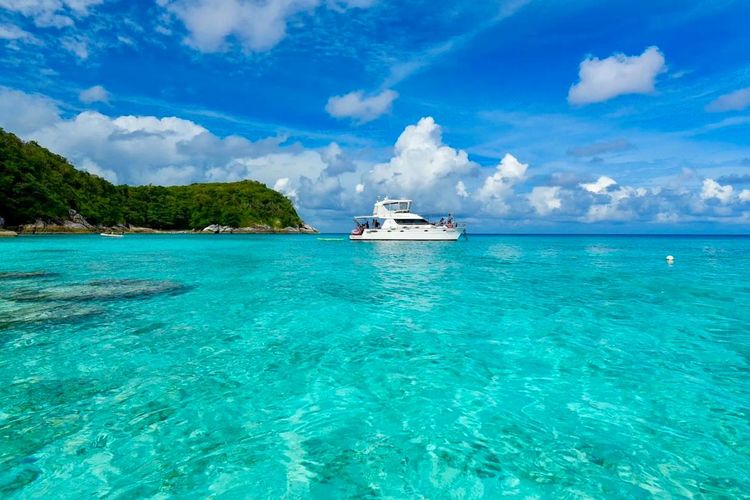
Promotional videos always depict scenes of turquoise seas and blue skies, with a gentle breeze caressing your face, but the reality is this: while the Caribbean’s winter scenery is truly breathtaking, in the summer—especially from July to October—the scorching heat waves and thunderstorms will make you question the meaning of life.
In August 2022, I set sail from Saint Lucia. The sun was still high in the morning, but by 2:00 p.m., the sky had suddenly darkened, as if dyed with ink. Within just 15 minutes, the wind speed surged from 12 knots to 35 knots.A catamaran handles downwind conditions well, but when hit by a crosswind, its rolling motion is more intense than that of a monohull—it’s not just a simple sway, but more like a “shudder.”
Data Reference:
According to data provided by NOAA (the National Oceanic and Atmospheric Administration), the frequency of convective thunderstorms in the Caribbean region from July through October is 4.7 times higher than during the dry season, and the average number of days per month with wind speeds exceeding 30 knots is 5.2.
BNR Specific Scenario:
How their boats perform in strong winds depends on the boat’s age. Older Lagoon models (pre-2015) have a flawed deck drainage design, causing water to surge back into the cabin through gaps on either side of the helm after waves crash against the deck. I once witnessed a family whose bedding in the cabin was completely soaked, forcing them to sleep on the helm chairs that night.
Things to Avoid:
From July through October, avoid offshore routes as much as possible. Coastal routes, such as from Saint Lucia to Martinique, are comparatively safer.
Before departure, download two apps: Windy and PredictWind. Don’t rely on just one of them—the free weather briefings provided by BNR sometimes show conditions from the previous day and aren’t very reliable.
If the forecasted wind speed exceeds 25 knots, the BNR’s charter manager will usually suggest that you cancel your trip or change your route. Follow their advice—they’re not doing this to reduce your costs, but because they genuinely fear an accident might occur.
| Month | Average Wind Speed (knots) | Number of Days with Thunderstorms | Recommended Route |
|---|---|---|---|
| January | 16 | 1.1 | Grenadines Archipelago |
| April | 13 | 2.3 | Saint Lucia–Martinique |
| July | 18 | 5.2 | Avoid the open sea; stay close to shore |
| October | 17 | 4.8 | Same as above |
Question 5: Which of these “high-end features” on board is the most useless?
The ice maker.
Seriously, I have no idea who came up with this idea—putting a machine with an extremely high failure rate on a seagoing vessel. In the BNR fleet, more than half of the ice makers break down within the first week. It’s not that they make ice too slowly; they simply stop working altogether.
The reason is very simple: seawater causes corrosion, the voltage is unstable, and there’s constant vibration. When these three factors combine, the ice maker becomes completely useless.
This was my fourth time chartering a BNR vessel—a 2022 model—and the ice maker broke down on the third day. When I called the base, they said, “It’s no big deal; you can use manual ice trays,” Manual ice trays? Was my family’s dream of drinking ice-cold Coke this summer really going to be shattered just like that?
A more practical alternative:
Before departure, purchase several large insulated coolers (YETI brand or similar) and buy a whole bag of crushed ice at the marina—convenience stores at Caribbean marinas usually sell them for $1 a bag.
If the temperature inside the boat’s refrigerator isn’t as low as it should be, you’ll need to check it beforehand. On some BNR boats, the refrigerator’s weatherstripping has deteriorated, causing all the cold air to escape.
Don’t count on the ice maker. The money you save will be enough to buy ice for half a month.
Question 6: What are the “hidden fees” that beginners most often overlook?
The restroom.
Yes, you read that right. Not fuel costs, not dock fees—toilets.
Catamarans use a vacuum-based waste disposal system for their toilets. If this system becomes clogged, the repair costs will make you want to cry. BNR’s contracts typically state: “Toilet clogs are considered misuse, and the cost of repairs shall be borne by the charterer.”” Each unclogging costs between $150 and $250.
A tragedy I witnessed firsthand:
A family from Denmark rented a boat from BNR. Their children carelessly flushed wet wipes down the toilet, causing the wipes to become tangled in the vacuum tubing and eventually completely clog the entire system.A repairman flew in from Grenada, took three hours to fix the problem, and the final bill came to $480.
Essential Tips for Beginners:
Only use the designated toilet paper on board. If it’s not on the boat, don’t flush anything down the toilet.
Always check the instructions before flushing. The BNR system has two modes: dry flush (vacuum only) and wet flush (with water). The dry flush is easier to use and less prone to clogging.
If you notice the toilet isn’t flushing properly, do not force it. Stop using it immediately and call the base to report a “system malfunction.” Even if you’re the one who caused the clog, this will save you the cost of an on-site repair.
Question 7: How do you choose an anchorage in the Caribbean to avoid disaster?
Choosing an anchorage is really about ensuring “a good night’s sleep.”
Catamarans have a shallow draft, typically ranging from 1.2 to 1.5 meters, so it might seem like they can anchor just about anywhere. However, the problem is that catamarans are equipped with anchor chains that are insufficient in weight.Monohulls use 35-kilogram anchor chains, while catamarans are generally equipped with only 20-kilogram chains. This is manageable on sandy or muddy bottoms, but on seagrass or rocky bottoms, the anchor will slide right in—just like a hot knife through butter.
Anchoring equipment on BNR boats: The anchor they use is a Delta anchor, which falls under the general-purpose category.It performs reasonably well on muddy bottoms, but on seagrass or gravel bottoms—it’s practically a joke.
In June 2023, I dropped anchor off Beccia Island and watched as the anchor chain was paid out at a 5:1 ratio; it felt quite secure.At 2:00 a.m., the wind shifted. The anchor was dragged right off the seabed, and the boat drifted about 200 meters, nearly crashing into the nearby reef. Fortunately, the crew member on watch noticed it in time; otherwise, we would have made the news that night.
The golden rule for choosing an anchorage:
Prioritize bays with “horseshoe-shaped” natural protection, such as Hog Island in Grenada and Wallilabou Bay in St. Vincent.
Do not anchor at the entrance to a channel. In the Caribbean, there are many ferries and supply vessels. These ferries and supply vessels travel at extremely high speeds through the channels in the middle of the night.
Before setting out, use Navionics to check the seabed composition. If the results show “Grass” or “Rock,” find another spot.
For catamarans, the recommended anchor chain length is a 7:1 ratio. Even if the water is only five meters deep, you should drop 35 meters of chain. That extra chain is like purchasing risk protection—it’s essentially a form of insurance.
Question 8: Is BNR’s insurance really “protection” or just a “scam”?
BNR insurance comes in three tiers: Basic, Standard, and Comprehensive.
Basic Coverage has a deductible of 1 percent of the boat’s value. For a boat worth $300,000, the deductible would be $3,000. This means that even for something as minor as a scratch on the paint, you’d theoretically have to pay $3,000 out of pocket.
With Standard Coverage, the deductible drops to 0.5 percent, or $1,500. However, it’s important to note that this plan does not cover sails. If the mainsail is torn by the wind, replacing it would cost between $2,000 and $4,000.
Comprehensive coverage: The deductible is $300. On the surface, this sounds flawless.However, the comprehensive coverage plan offered by BNR contains a hidden clause—“restricted sailing area.” If you sail beyond the area they’ve designated, the comprehensive coverage automatically becomes invalid. This area is generally defined as a 50-nautical-mile radius centered on the home port.
My personal approach:
Whenever I rent a boat from BNR, I always purchase full coverage. With a $300 deductible, even if I were to be involved in an accident, it wouldn’t put me at risk of bankruptcy.
Before setting sail, I ask a staff member to mark the “permitted navigation area” on a map and take a screenshot of it with my phone to keep for reference.
If you plan to sail beyond the 50-nautical-mile limit—for example, from Saint Lucia to Martinique, which is about 60 nautical miles—you’ll need to apply in advance to have the area expanded. The cost is roughly an additional $150 per week. It’s well worth the money.
Frequently Asked Questions (Q&A, in random order)
Q1: I’ve never sailed a catamaran before. Does BNR allow beginners to rent one?
They do allow it, but they require you to provide a “sailing resume” detailing the waters you’ve sailed, the types of boats you’ve operated, and your total mileage. If your resume is insufficient, they’ll require you to take a mandatory one-day training course. The fee is $350, and the course is held at their Grenada base.I suggest you don’t skimp on this expense. What you’ll learn in that course is more practical than what you could gain from three years of self-study.
Q2: Can I bring a drone on board?
However, BNR’s contract includes the following provision: “Operating a drone requires a permit issued by the local government.” Regulations regarding drones vary among each island nation in the Caribbean. Saint Lucia explicitly requires advance application, while Grenada outright prohibits drones from flying over beaches and protected areas.The last time I was flying in St. Vincent, a park ranger stopped me via walkie-talkie. He said, “If you keep flying, I’ll confiscate your drone.” So, be sure to check local laws in advance. Don’t push it too far.
Q3: What are the most worthwhile items to bring?
There are two items: first, a portable Bluetooth speaker—preferably a waterproof model like a JBL—and second, a USB-rechargeable LED light.The lights that come with the boat aren’t always bright enough, and the position of the bedside lamps is often extremely awkward. I own a boat where the bedside lamp is inside a cabinet—it can’t even illuminate the bed at all.An LED light clipped to the headboard is perfect for reading, finding your socks, and it saves on battery power.
Q4: Do BNR boats have Wi-Fi?
It’s available on some boats. However, the Wi-Fi signal on their boats has absolutely nothing to do with the word “stable.” When you’re in an area designated as an anchorage, it’s basically nonexistent.When docked at a marina, the connection is barely strong enough to scroll through your social media feed. If you need an internet connection for work, you’ll have to purchase a local eSIM card on your own. A provider called Dent Wireless offers decent coverage in the Caribbean; 10GB of data per month costs about $30.
Q5: Is the security deposit refunded quickly?
Yes, it’s quick. I’ve rented a boat four times, and the slowest refund was the day after I returned the boat. However, this is contingent on the following conditions: there’s no damage to the boat, nothing is missing, and the fuel tank is full.If they have any concerns, they’ll withhold a portion of the deposit and won’t refund it until the inspection is complete. This process can take up to a week.