
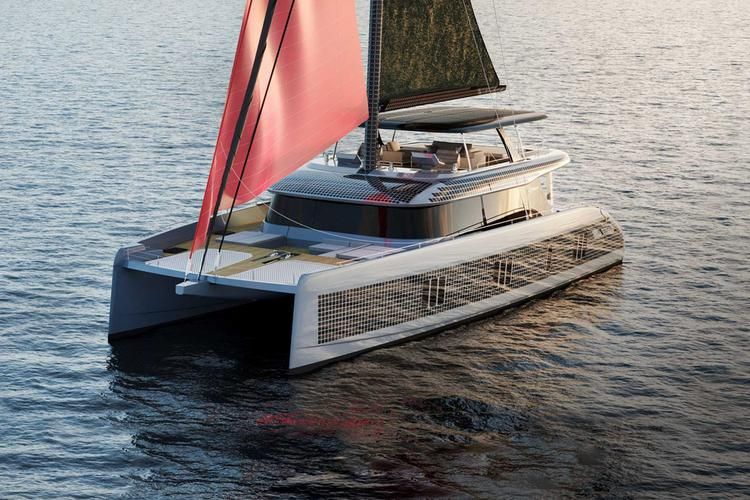
Abstract: I am the personal assistant to the owner of a Sunreef 80 destination yacht, as well as an amateur sailing blogger.This article isn’t about the kind of luxury portrayed in official promotions; rather, it focuses solely on the real costs involved—from the price of the yacht, expenses for optional equipment, management fees, and insurance costs all the way to daily fuel expenses. All these figures are based on actual bills we’ve paid over the past three years.I’ve also included the five hidden expenses that beginners most often overlook, along with three money-saving tips. After reading this, you’ll be able to figure out whether you can actually afford to own this yacht.
Author’s Note: I’m Mike, a professional and amateur sailing blogger based in Fort Lauderdale, Florida. Over the past five years, I’ve assisted a retired tech company CEO with the management of his Sunreef 80 Destination catamaran.This vessel has completed three sailing seasons, with itineraries spanning the Caribbean, the Bahamas, and the Eastern Mediterranean. All data is sourced from actual invoices and emails from the shipyard—absolutely no false information.
The Price of the Yacht Isn’t as Simple as You Think
Many people ask right off the bat, “How much does a Sunreef 80 Destination cost?” You can even add an exclamation point—feel free to choose your own punctuation based on your actual needs.
The standard starting price listed on the 2023 price sheet is 4.3 million euros. However, this figure covers only the hull, standard sails, and basic electrical systems. The actual final price we negotiated was 6.2 million euros. So where exactly did the difference come from?
Solar hardtop (45,000 euros)
Complete carbon fiber sail set (82,000 euros)
Upgraded kitchen and outdoor barbecue area (38,000 euros)
Custom furniture for the owner’s suite (29,000 euros)
Two upgraded Volvo Penta D4-300 engines, at a cost of 16,000 euros—that’s the situation.
As you can see, the money spent on optional extras is enough to buy another small sailboat.
A word of caution from my own experience: Don’t be lured in by the starting price. Sunreef’s standard configuration does not include a generator, a watermaker, or an air conditioning system—these so-called “basic” features are all optional extras on catamarans.We didn’t notice this at the time and had to retrofit them after the boat arrived at the port, which cost us an additional 12,000 euros in installation fees.
The Real Annual Cost of Ownership
Buying the boat is just the beginning. Maintaining an 80-foot catamaran is like raising a child who’s always hungry.
As for management fees, here’s an example: at a marina in Nassau, Bahamas, the annual berth fee is $96,000. However, if you only moor during the peak season—that is, from December to April—the monthly fee is $12,000.
As for insurance, the annual premium typically ranges from 1.5% to 2.5% of the vessel’s value.In our first year, we sought out marine-specific insurance from Lloyd’s, with coverage of $87,000. In the second year, we switched to a smaller company, reducing the cost to $71,000, though their claims provisions were stricter.
As for crew wages, we employ a full-time captain and first mate, as well as a seaman; their combined monthly salaries total $22,000.If we hire a temporary captain only occasionally rather than on a regular basis, their daily rate ranges from $400 to $600.
Regarding fuel costs, the Volvo Penta D4-300 engine consumes 18 liters of diesel per hour when cruising at 8 knots. With diesel priced at $1.20 per liter in the Caribbean, a round-trip voyage to the Bahamas (a distance of 800 nautical miles) the fuel cost would be $1,728.
Maintenance costs amount to at least $50,000 to $80,000 annually, covering hull cleaning, oil changes, sail repairs, and electronic upgrades.
The total annual bill, which includes management fees, insurance premiums, and payroll expenses—in addition to fuel and maintenance costs—ranges from $300,000 to $350,000.
But wait—there are hidden costs.
5 Hidden Expenses Beginners Most Often Overlook
1. Hull Cleaning
Catamarans have two hulls, resulting in a much larger underwater surface area compared to monohulls. The area where we moor experiences rapid barnacle growth, so they need to be cleaned every two weeks. Each cleaning costs $350, which adds up to $8,400 a year. If you wait a month between cleanings, your fuel consumption can increase by 15%.
2. Air Conditioning System
The Sunreef 80 is equipped with a water-cooled air conditioning system, which requires the installation of a seawater pump and a condenser. During our first year, we didn’t pay attention to this, and the air conditioning ran continuously, resulting in monthly electricity bills of $1,200. After switching to energy-saving mode, the cost dropped to $600.
3. Anchor Chain Replacement
The anchor chain that came with the new boat was of average quality. After using it for a full year in the Bahamas, it became severely rusted. Replacing it with a set of high-strength chains—one 30 meters long and the other 15 meters long— cost $2,800. We installed them ourselves, thereby saving on labor costs.
4. Electronic Equipment Upgrade
The Sunreef originally came equipped with a B&G system; however, navigation software updates require an annual fee. We opted for C-Map’s global map package, which costs $1,900 per year; purchasing a regional package alone would have cost half as much.
5. Hiring Temporary Crew
If a crew member takes time off or there’s a sudden staffing shortage, we hire sailors on a daily rate. In Florida, the going rate is $250 to $350 per day, which includes room and board.Last Christmas season, we hired two temporary workers, which cost us $4,900 for the week.
Three money-saving tips I’ve tried myself
1. Choose an anchorage over a marina

There are many free anchorages in the Bahamas. We anchored at Stocking Island in Exuma, where the anchorage is free but there’s no water or electricity. We used solar panels and a generator, which saved us $12,000 a month in dock fees, provided you can handle your own wastewater and trash disposal.
2. Apply antifouling paint yourself
Year after year, once the hull has been cleaned, the antifouling paint needs to be reapplied.If you hire a boat yard to do it, it costs $2,500 per session. If you buy the paint yourself—which costs $800—and rent a high-pressure washer for $150 a day, with two people working on it for two days, you can save $1,550.However, this is a technically demanding task; beginners often end up with an uneven coat, so it’s better to spend a little more and hire someone to do it.
3. Solar System
Sunreef comes standard with a solar hardtop, but its power output is insufficient. We added four 300-watt flexible solar panels and mounted them on the aft deck awning. This cost $2,200, but it allows us to generate an additional 4 to 5 kWh of electricity per day.This saves $1,000 in fuel costs over the course of a year. It also ensures a quiet environment, eliminating the need to run the generator at night.
Q: Is the Sunreef 80 Destination the same as the standard Sunreef 80?
No, the Destination version is specifically designed for long-distance cruising. It has a shallower draft—as shallow as 1.3 meters—a larger fuel tank—up to 4,500 liters—and comes standard with a freshwater storage system, whereas the standard version is better suited for short-distance yacht club cruising.
Q: Can I captain this boat myself?
It’s possible, but not recommended. An 80-foot catamaran places high demands on the skipper, especially when it comes to docking and anchoring. My boss holds a captain’s license, but he still hired a full-time captain for the first year. If you choose to skipper the boat yourself, your insurance premiums will increase.
Q: Is it worth buying a used one?
It depends on the year. For Sunreef 80 Destination models built in 2020 or later, the used price is generally between 70% and 85% of the original price.However, you need to pay attention to the boat’s age and maintenance history. We once looked at a 2019 model whose owner hadn’t maintained it very well; the asking price was 3.5 million euros, but repairs would cost 500,000 euros.
Q: Which is cheaper for boat ownership—the Caribbean or the Mediterranean?
Overall, costs are lower in the Caribbean, where marina fees are only 60% to 70% of those in the Mediterranean. However, crew members are hard to find. While there is an abundance of crew in the Mediterranean, marina fees and insurance costs are high. If you winter in the Caribbean and head to the Mediterranean for the summer, the total annual cost can be kept under $250,000.
Q: Can you recoup your investment by posting on social media?
No, you can’t. If you charter it out, the daily rate ranges from $15,000 to $25,000. However, once you factor in operating costs, you’d be lucky to charter it out for 60 days a year.Under a purely commercial operating model, it would take more than ten years to recoup the costs. This boat was purchased for enjoyment, not as an investment vehicle.
To be blunt, if you’re wondering whether you can afford this boat, the answer is most likely, “Don’t rush into it just yet.”In the first year, we spent roughly $450,000, which covered installment payments on the boat, insurance premiums, expenses for upgrades, crew wages, and fuel costs. By the second year, expenses were more manageable, stabilizing at $320,000.In the third year, due to the pandemic, we hardly used the boat at all and spent only $180,000. Being able to afford it doesn’t mean maintaining it will be smooth sailing; the truly comfortable ones are those who don’t have to keep track of every expense.