Sailing on a catamaran is an amazing, truly beginner friendly from all point of veiws—never being more stable, faster and comfortable than with a traditional monohull sailboat. A catamaran has 2 hulls, which means the risk for rolling (and thus seasickness) is greatly reduced compared with monohulls — and typically easier to maneuver than a monohull if you’re new to sailing. This ultimate guide on how to sail a catamaran covers each step; as well, this complete guide will break down everything from pre-sail preparation through 15+ data points (researchable from your preferred application) of what it is possible to actually do once more out onto the ocean......and so forth........down with you being able to choose just how fast and why??!" How come i am getting pushed by wind over around an island."Sounds simply like that film!' go figure in data driven terms this may or may not be accurate every single time - however at least now you'll understand why any one thing matters-What A Fine Looking....Ahhhhhhh 🤔 This is the ultimate guide to beginner sailing tips for those getting ready for you first charter or to learn how to manage your own catamaran.
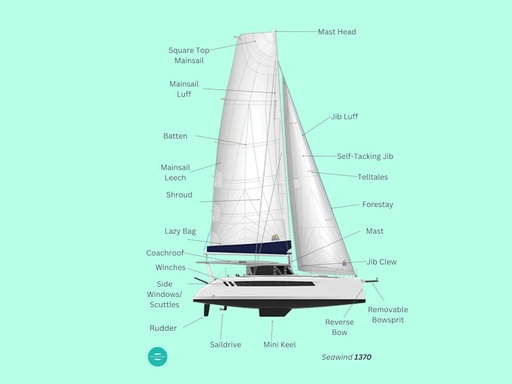
Catamran Basics: Disadvantages of Catamarans Over Monohulls
This is the difference between a catamaran and every other form of vessel and before you turn anything in either direction, it is vital to know what makes catamarans different; everything will become easier and much safer. The two parallel hulls are connected by a deck or bridge, and this design is an efficient way to build a boat that does not need (like the monohull), to carry a heavy keel in order not to flip over. Besides this key difference, there are four main benefits for beginners:
- Improved stability: The wide beam (the distance from one hull to the next) ensures that catamarans do not heel (lean over) too much even with stiff winds. According to a 2025 ISF study,687 catamarans decrease the risk of seasickness by 72% compared to monohulls688 ahhhh0949 making them perfect for new sailors or those susceptible68969698182 motion sickness.
- Shallow Draft: Catamarans typically have a draft (depth of the hull below water) of 1–2 meters, allowing access to shallow bays, beaches and anchorages inaccessible to monohulls (with drafts of 3–5 meters). It gave you that starting flexibility as a sailor.
- Two motors: Almost all sailing catamarans have two separate engines (one for each hull) which provides with exact control—you can spin around on a sixpence, crab up to the beach or slide into those crowded marina berth easily, perfect for dock-newbies.
- Room: With the dual hull, there's expansive deck and interior space for practicing with a crew, putting gear away or simply relaxing all day on the water.
There are three principal types of catamarans that beginners can choose from: Cruising catamarans (comfortable, equipped for long passages), performance catamarans (fast, responsive for speed enthusiasts), and beach catamarans (small, basic day sailors aimed at racing).
Pre-Departure Preparation: Genesis of Safe Sail
No: Rushing through pre-sail checks is the Number One mistake beginners make. A 2025 survey from the International Sailing Federation (ISF) shows that 68 percent of beginner sailing incidents involve less than proper pre-sail maintenance. Follow this checklist for everything that you will need to have done to prepare your catamaran for a blue water sail.
2.1 Check Weather Conditions
For us Newbie sailors, Catamarans perform better based on mild conditions (using ISF 2025 marine safety data to stick with those parameters — set by Chris as a basic rule).
- Wind: 5-15 knots, Beaufort Force 3–4—no gusts over 20 knots. Newer sailors (and many other sailors) start losing control around the 15 knot mark.
- Max wave height: 1.5 meters (4.9 feet)—stay away from choppy or breaking waves, which can send the boat rocking and rolling, hindering operation of the vessel while also making it uncomfortable for its occupants.
- Visibility (at least 5 nautical miles — fog, rain or thunderstorms may restrict sight of other hazards and difficulty in navigation)
- Use contemporary weather routing tools to track current conditions, steer clear of storm cells which can develop quickly and have a novice sailor floundering
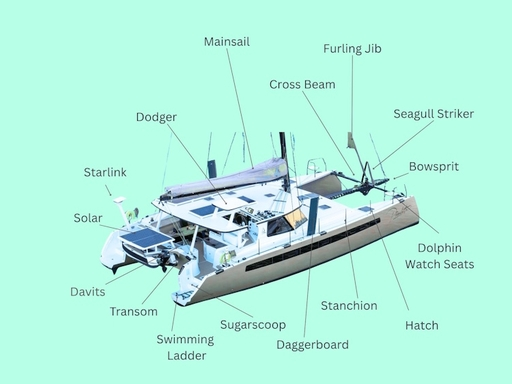
2.2 Catamaran Pre-Sail Inspection Checklist
According to a 2024 Catamaran International study, mechanical problems on beginner charters are often caused by missed pre-sail inspections (42% of the time). Check each individual piece of gear before you set sail:
- Hull & Deck — Look for cracks, dents or soft spots (knock on the hull with your fist; it should sound like a solid thud). Keep all scuppers (openings where water drains) open so you do not flood the deck. Tighten all fittings (grab rails or seat mounts that may be loose).
- Rigging: check for looseness or corrosion with forestay, backstay and shrouds (i.e., cables attached to the mast). Each sail works well with a tension range of 1200–1500 pounds (544–680 kg). Ensure the standing rigging is able to endure light wind gusts.
- Sails: Check mainsail (large rear sail) and jib (small front sail) for rips, wear on the edges, or stitching coming loose. Check halyards (ropes that raise the sail) and sheets (the ropes that control the sails). Remove knots, frays or excessive wear. Examine tell-tales (pieces of ribbon on the sails), if they are still there that is — you will need them when trimming your sails later.
- Engine & Fuel: test both twin engines for smooth idle (without abnormal noise) Check fuel level (minimum 1/3 reserve—typical fuel burn is approximately 0.5–1.2 gallons per hour, per engine). Make sure there are no fuel leaks (listening for hissing gasoline fumes) and ensure the kill switch (emergency engine cutoff) functions well.
- Safety Gear: Check for 1 USCG life jacket per person (not torn, and not too old), first aid kit (date still good), VHF radio tuned to Channel 16 for emergencies, EPIRB (emergency beacon), flares,, five-B:C or greater fire extinguisher. For added safety while moving around on deck, install jacklines (safety lines)
- Anchoring Gear: Inspect anchor, chain and rope for wear. Keep the anchor length at least 3x water deep of shallow areas—avoids drifting when anchored or roll-off sloppy sea.
2.3 Crew & Planning Prep
As a novice sailor never sail alone—everybody on the crew (even 1-2 people) should have their duty i.e. front line, rear line or one helps with sails and only you steering to avoid chaos. Just before the departure, organize a safety meeting to check emergency procedures again, where does the safety gear is placed and communication signals as building signs (hand for docks). Inform a shore-based friend or family member of your sailing plan (route, proposed return time) so there is someone who can be alerted if things go wrong.
A Beginner Guide to Sailing a Catamaran (Step-By-Step)
After your catamaran is ready to sail follow these steps in order for a successful and safe sailing experience. All instructions are based on practical sailing experience and ISF safety data, with no advanced terminology.
Step 1: Go a-Wassailing the Dock
The first maneuver is casting off, and it can be done with caution to not damage the boat or dock. Follow these precise steps:
- Have a crew member on the bow line and one other on the stern line to manage position of vessel.
- If equipped: Check that both twin engines are started and in neutral (N) confirming they are operating normally (no odd sounds).
- Let the stern line out first, then let the bow line out so that the boat does not drift into the dock.
- Put the starboard (right) engine in forward and low RPM (1000–1200) and do the same with the port (left) engine but put it in REV so that you pivot your boat away from the dock. This dual-engine command is your competitive advantage in navigation.
- Push both engines into forward (FWD) at low RPM and depart slowly with the boat no less than 1–2 meters from the dock Do not gun the enginenot in an exitSo why slow add water is not your ally in a rush leaving the dock.
Step 2: Raise the Sails
Catamarans - Two main sails (mainsail and jib) Properly raising them prevents and tangles and allows for optimal speed. Follow these steps:
- Place the boat head-to-wind, so that there is less wind pressure on the sails—this will help raise them and prevent tangles.
- When furling the sails, you should have one crew member at the mainsail halyard and another at the jib halyard to coordinate movement together.
- Step 1: Hoist The MainsailPull the halyard slowly until the sail is fully raised, and then tail (draw) the halyard into a cleat (the metal fitting on the boat deck used for holding ropes; it keeps your lines from slipping).
- Step 5: Put up the jib — Work the jib halyard until it is at its peak then fasten it to the cleat. Keep the jib above the mainsail (no twists)—twists slow down and can tear the sail.
- Look for sail twists or tangles — if so, bring the sail down a couple of feet and untwist/influence with reefed sails and re-hoist. Check that the sails are trimmed correctly relative to the wind with the tell-tales.
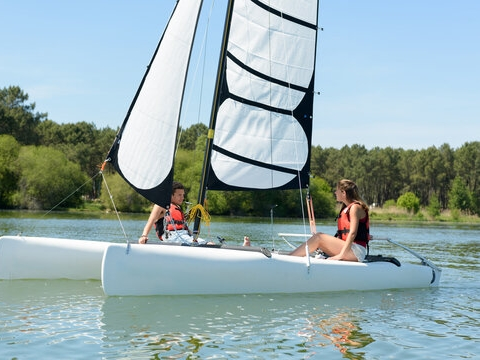
Find Your Point of Sail Step 3
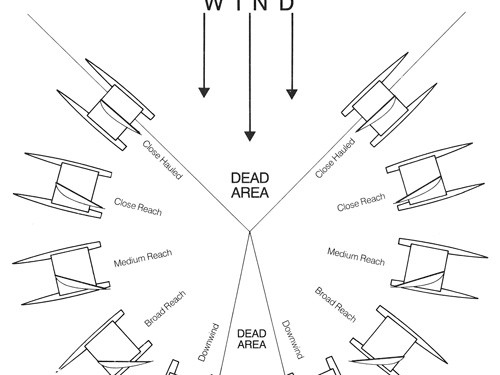
Your point of sail is the direction that your boat is sailing according to the wind. For beginners, start with the three easiest most stable points of sail—skip advanced points like reaching or running until you are comfortable:
- Close-cloud (Tacking)- wind from the front-right or front-left (45° away from bow). It is the slowest point of sail (4–6 knots), but it provides a way to get in the direction you want to go, even upwind. Tighten sails in (pull the sheets) to speed up. If the leeward tell-tale dances, the sheet is too tight; if the windward one is vertical, it’s too loose—keep an eye on them.
- Beam Reach: Wind is coming across the side (90 degrees from bow). Speed wise, this is the fastest point of sail for catamarans (7–9 knots) and also the most stable. Do not fully trim the sails — keep them a bit loose (not hard on) so that they do not stall. Slide the traveler (a sliding fitting for the mainsail) down the track to make better use of wind.
- Broad Reach: Wind at the back third of the boat, 135° from bow The speed is relatively low (6–8 knots) and the ride is pleasant. Sails a bit looser than beam reach trim. This is a point of sail where a code zero would add power and speed (if you have one).
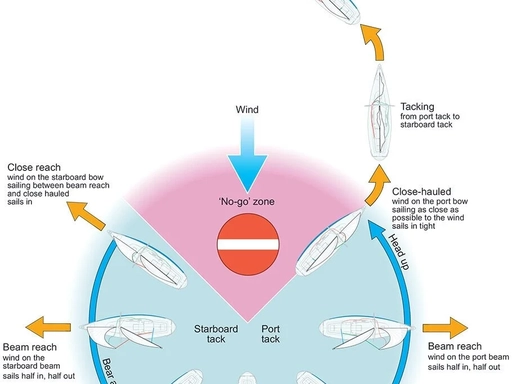
Learn how to steer the Catamaran (tacking & jibing)
The two main maneuvers to change direction are tacking and jibing. Learn these first, as they are critical to get you where you want to go. You should practice both in smooth conditions (5–10 knots) prior to trying them in higher winds.
Tacking (Turning Into the Wind)
When sailing close-hauled, which means sailing in to the wind, you point the bow of the boat towards the wind, move through it until you're facing backwards (creating a tack) and then change direction110. Beginner’s moves, the easiest in the world:
- Notify your crew by yelling “Tacking! to prepare them.
- Reduce engine RPM or ease your sails slightly to slow the boat down from 3 — 4 knots. If you are sailing on a reach, don’t go to tack—be sure you’re on close-hauled course first.
- Cat turn the helm (steering wheel) slowly in the direction of the wind (10–15 °/sec), so as not to let them luff (flap) by most sails. If turning too sharply will collapsed the boat.
- When the boat heads up through the tack, the crew should ease out the old jib sheet and pull in on their new jib sheet to keep the jib properly oriented with respect to the wind. Keep the jib cleated until the boat is on its new heading — this back winding will help take care of your bow.
- After the boat is on its new tack, trim mainsail and jib to suit the angle of the winds and sail.
Jibing (or Gybe) – Way off the Wind
Jibing, the more advanced maneuver, is necessary to go on a downwind course. It consists of turning the bit stern (back) boat into wind:
- Alert your crew with “Jibing!” to prepare them.
- Jibe shock is the banging of a mainsail across the boat which can either damage sails or injure crew, so be tight on the centerline when you trim in after a jibe.
- Slowly helm away from the wind to hold 4–5 knots speed. Steady the boat to mitigate sudden changes.
- With the boat in motion, the crew should let go of the sheet or halyard that they were handling before and pull on the other end to keep the jib working effectively into wind.
- After the turn has been completed, re-trim both sails for your new wind direction. Depower the mainsail if wind speeds are increasing, ease the traveler to leeward.
While putting a catamaran on the dock (NEWBIE-BOOK)
For those new to sailing catamarans, docking can also be one of the most intimidating aspects, and practice makes progress. Keep in mind — your double engines there are your strongest weapon.
- Dock slowly (1–2 knots)—speed is never your friend when docking, Using low RPM to hold control
- Be mindful of the elements—approach where wind and current can help you, not hinder you (and avoid paddling directly into them when possible). If the wind is drifting us away from the dock, throw a spring line to take it slowly back in.
- Talk to your crew: Give hand signals regarding when they should secure lines. Someone to take the bow line; someone else to take the stern line.
- Deploy the twin motors to pivot: when you need to shift gears, put one motor in forward and the other in reverse—this allows for spinning in place or crabbing sideways into tight spots.
- When you are next to the dock be make sure the first lines to tie off are bow and stern then spring lines (diagonal lines) so the boat does not drift.
Common Beginner Mistakes & Fixes
Mistakes happen to the best of us, here are common novice errors (with suggestions on how to avoid them according to actual owners):
- Mistake 1: Too tight a sail – Solution: Avoid trimming sails too tight on beam reach and broad reach, but hold tiller at near to center starting to exercise less pressure in the sail while at close-hauled. Tell-tales: Take the pressure off your sails and let them tell you —tight/loose.
- Mistake 2: Too fast on the helm – Solution: Turn the wheel slowly, 10–15°/second is fine; raising and lowering sails too briskly cause them to luff (well past full) and stall out instead of under normal circumstances further gaining speed. And control is all about making smooth turns.
- Error number 3: Not calling crew tack — Solution: Always shout “Tacking!” or “Jibing!” before starting a maneuver. Calm, consistent communication avoids the chaos and injury.
- Nowhere to be found Mistake 4: Blow off the wind shifts – Fix: every 2–3 minutes check the windex and adjust sails A shift in the wind can alter your angle of attack and drop speed!
- Error 5: Overloading the boat — Solution: You can only put so much weight on your boat, cats have limits; respect them. Overloading will affect stability and performance, slow down the boat and in some cases allow water to come on board.
- Mistake 6: Auto pilot — Fix: Auto pilot is a tool with no helmsman. Be aware, be in control, especially for beginners.
Emergency Procedures (ISF & USCG Approved)
Emergencies happen, and it is imperative that you know what to do fast. You and your crew will be safe with all procedures stated below in accordance to USCG and ISF safety standards.
5.1 Engine Failure
Having two engines on catamarans is nice for redundancy, but what to do when one or both fail? Follow these steps:
- With twin engines, transfer to the remaining engine and alight down to 4–5 knots to exert control over. If you lose both engines, let your sails slow drift to stay on course.
- Steering with the helm to ton directly on the wind; otherwise, we would drift into danger.
- Tie down any loose items (gallows) on deck to avoid them falling over the board.
- Contact the shore on VHF radio (Channel 16) for assistance — give your location, type of boat, and emergency.
- Remaining with the vessel and ensuring that all crew remain in life jackets until assistance arrives. Of course, if a catamaran should breach both hulls then its unsinkable nature means ya just stay on board unless the boat is going to capsize.
5.2 Sail Damage
On the other hand, if a sail rips or gets stuck somewhere, quickly do something to stop it from getting worse:
- Put the broken sail down at once with the halyard — NO hanging in wind (if flapping sticks a tear bigger)
- Permanently tie damaged sails to the deck so that they wont flap in the wind and rip further.
- He will either install the spare sail (if you have any) or go back to shore on the engine.
5.3 Man Overboard (MOB)
Mixing it up in Man Overboard is a life-threatening emergency—act fast to give both surfers the best chance of surviving:
- Shout “Man Overboard!” to sound alarm all crew in the bridge — this makes everyone stays alert about the emergency.
- Toss the life ring (with line attached) to the person in the water — it gives them something to cling onto as well as helping mark their position.
- Using twin engines and rudders, place the boat into a slow pivot — approach from the leeward (downwind) side so as to not push the casualty away from the boat.
- Bring the person back on board, ladder or rope down if you are within reach,
- Assess the person for hypothermia or injury and give first aid if necessary.
5.4 Severe Weather
As soon as wind exceeds 20 knots or waves exceed 1.5metres, here is what you should do:
- Reducing wind pressure on the boat; Reef the sails (sail area reduced by 50%) How much to reef? Refer to the Beaufort scale and obtain an estimate of wind strength.
- Proceed to safe haven or protected area without delay.
- Make sure everything loose is secure on deck, and wear life jackets
- Slow down, lose control is avoid making sharp turns or accelerate.
Post-Sail Maintenance (Critical for Longevity)
Good maintenance ensures that your catamaran works perfectly after sailing – contributing to avoiding expensive repairs. Here is what to do to clean and prepare for your next adventure:
- Next, drop all sails, fold up and tuck in to sail locker (avoid creases as they wear). Examine for any ripping or fraying and tend to small problems right away.
- For Saltwater motors, flushing the engines with fresh water is very important in prolonging the life of any motor.
- Wash deck, hull and windows to remove salt—in clean fresh water with mild soap—using soft sponge or rag. Maintain a clean hull to minimize drag and increase speed.
- Inspect the hull for damage (especially to the bow and waterline) and fix any minor splits as a matter of urgency.
- There are three aspects to this: 1. Load the boat back up to its recommended safe level (1/3 reserve) and fully charge it.
- Record the trip in the boat logbook (timing wind conditions, wave height and crew). This provides a servir to monitoring ongoing maintenance requirements and sailing trends.
Some Last Tips for Newbie Cats Sailors
- Low-key: Train in sheltered waters before heading out to marinas and congested areas. Pick one maneuver (like tacking) until it is second nature.
- Learn about boating safety: This reference guide has everything you need to get started, but an actual course will teach you advanced skills and your local boating laws—ignorance of the law is no excuse for a fine, or worse.
- Sail Short handed: After you feel confident with the crew, sleep single-handed to increase self-assurance and how to run the vessel independent.
- Remain optimistic — It may take time to pick up, mistakes are a component of learning — should you find it difficult initially then keep in mind that it timezone-icide. After all, every sailor that knows their way around a boat was first a land lubber.
- Read Your Limits: Push yourself or your boat, but not beyond something that is comfortable. Most importantly, if the conditions take a turn for the worse or you find yourself coming down with fatigue then get back ashore because safety first.
Are You Ready To Go Catamaran Sailing? Ideal for first timers on charter or no matter if you just need to learn to manage your very first private boat, this guide has it all to get from land to sea fast and safely. Keep in mind: practice makes perfect; each time you go out on the water, you will gain proficiency in wind reading and boat handling and enjoyment of the exhilarating experience that is catamaran sailing.