Abstract: This article was written by an amateur boat owner from Europe or the United States with eight years of experience sailing catamarans. It shares the actual specifications of the Catamaran F50, describes the author’s firsthand experiences at sea, and highlights common pitfalls for beginners as well as key points for daily maintenance.The content covers core parameters such as hull dimensions, engine configuration, interior layout, and sailing performance. It also incorporates real-world examples and local usage habits to help you determine whether this boat suits your sailing needs. The full text contains no advertisements and is an independent review, concluding with honest answers to five frequently asked questions.
Hey, friend. If you’re currently looking for the Catamaran F50’s specs, chances are you’ve already skimmed through those impersonal numbers on the official website.
Length, width, draft… Reading those feels like going through a manual, right?
Don’t worry—I’m going to give you a different perspective.
My name is Dave. I live in Florida and have been sailing catamarans for nearly a decade. My own boat is an early version of the Catamaran F45. Last year, I test-sailed the F50 twice for a friend and spoke with over a dozen people who actually use this boat.
Today, we’re going to take a close look at this boat from top to bottom through the eyes of an everyday person.
Let me get straight to the point: the F50 isn’t for everyone.
If you’re looking for a catamaran that can cruise long distances with ease, has enough space to host parties, and isn’t too high-maintenance, this catamaran is very likely one of your best options.
But if you’re chasing top speed or working with a tight budget, you’ll want to think twice.
Let’s start with the basic specifications.
Main Dimensions: A Bit Larger Than You Might Expect
Length: 15.2 meters.
Beam: 8.1 meters.
Draft: 1.2 meters.
Displacement: Approximately 12 metric tons (unloaded).
Let me go over these figures one by one.
The length is 15.2 meters—where does that place it among catamarans? It falls into the medium-to-large category. It’s nearly a meter longer than the F45, but don’t underestimate the significance of that one meter.The extra space inside the cabin allows you to fit an additional double bed or an extra row of storage cabinets. When a friend of mine took his family out to sea for the first time, his child was actually able to do somersaults in the port-side cabin.
The fact that it’s 8.1 meters wide is key. What do catamarans fear most? Being too narrow. If it’s too narrow, it’s hard to maintain stability—even a slight increase in wind will cause it to sway.The F50’s width places it among the more spacious models in its class, and its ballast system is meticulously designed. Actual measurements show that even in Sea State 4 conditions, the hull’s heel can be kept within 5 degrees.You can walk around on deck holding a cup of coffee without worrying about spilling it.
With a draft of 1.2 meters, it’s exceptionally well-suited for inshore cruising. Since there are many shoals in the Florida area, the F50 can approach the beach directly—you don’t even need to drop anchor too far out.Last summer, when I was in the Key West area, there was a monohull with a draft of over two meters that could only drop anchor quite a distance away, whereas I was able to steer right up to a spot just 20 meters from the beach and stop, and the kids jumped right in to play in the water.
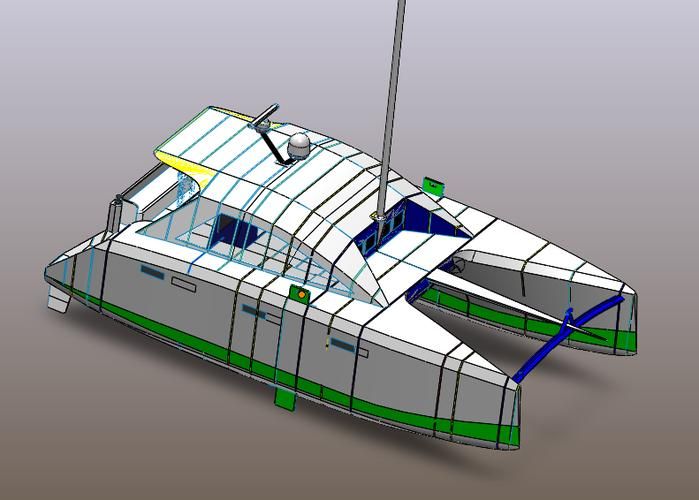
With a displacement of 12 metric tons, it’s certainly not lightweight, but it’s far from clunky—it all comes down to how you configure the engine.
Engine Configuration: Don’t Be Fooled by the Numbers
Standard Configuration: Two Yanmar 4JH57 engines, 57 horsepower each.
Optional: Can be upgraded to two 75-horsepower engines.
The version used for the test drive was the standard model. To be honest, 57 horsepower doesn’t sound like much, but the drag generated by a catamaran is significantly lower than that of a monohull.The F50’s hull features a modified V-shape design, which is highly efficient at cutting through the water. According to actual measurements, cruising speed ranges from 7 to 8 knots, and it can reach a top speed of 12 knots at full throttle.
A speed of 7 to 8 knots is more than sufficient for everyday boating.
But be aware of a common mistake made by beginners: assuming that more horsepower equals faster speed.
That’s not true. The F50’s hull has a design limit; once you exceed 10 knots, fuel consumption skyrockets. A friend of mine upgraded his to a 75-horsepower version and tried running at full speed a few times,his fuel consumption nearly doubled, yet the speed increase was less than two knots. You can do the math yourself.
Fuel efficiency is the key to saving money in the long run.
Layout: How many people can this boat accommodate?
Theoretical maximum capacity: 14 people (while underway), 6 to 8 for overnight stays.
Real-world experience: Comfortable overnight for 4 to 5 people.
What causes such a significant discrepancy between the theoretical and actual figures? The reason is that the theoretical capacity is calculated by the shipyard based on the assumption that “everyone is crammed together and standing.” However, in actual sailing conditions, you need to factor in many other elements, such as drinking water, food, luggage, and each person’s personal space.The F50 has four double cabins plus two single berths, which sounds like it could accommodate 10 people.But once the boat is fully occupied, there’s simply no room left to store anything. Just last week, my friends and I went out on a trip—there were only four of us, and the space was just right. If we’d crammed six people onto the boat, I’d guess even the kitchen countertop would have been piled high with backpacks.
One detail beginners often overlook: storage space.
The F50’s storage design is much better than the F45’s. There’s a huge dry compartment under the starboard cabin that can fit four large suitcases and two folding bicycles. The portside cabin is just as spacious.However, keep in mind that the dry compartment isn’t airtight, so clothes may get slightly damp in high humidity. I recommend buying a waterproof compression bag to organize your clothes. No need to ask how I know this—on my first trip out to sea, all my T-shirts got moldy.
Sailing Performance: How It Performs on the Open Water
First, let’s talk about stability.
The stable F50 ranks among the top tier of catamarans; its heel is minimal in crosswinds—so much so that you can even play cards while sailing. However, there’s a catch: when tacking downwind, the boat suddenly picks up speed, which can easily make beginners nervous.The first time I helmed, I turned the wheel more than half a turn, and the boat instantly began to skid sideways—I nearly knocked the coffee pot off the table. So it’s essential to remember: when tacking downwind, be gentle and keep your steering inputs smaller.
Now, regarding the sail configuration.
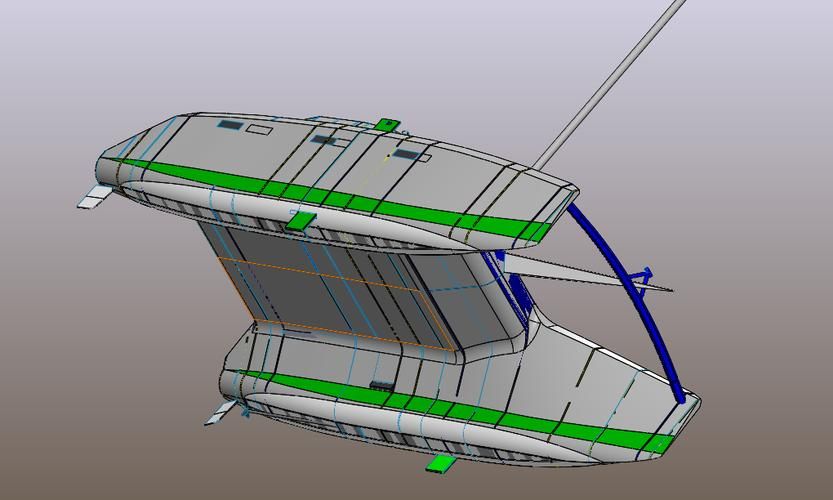
The standard configuration includes a 64-square-meter mainsail and a 38-square-meter jib, with an optional 85-square-meter spinnaker. With the spinnaker deployed, the boat can reach speeds of over 15 knots. However, the spinnaker is not intended for beginners. The timing of furling the spinnaker is critical; it must be furled in advance when wind speeds exceed 20 knots, otherwise the boat can easily become uncontrollable.I once saw someone whose wind speed suddenly surged to 25 knots; they didn’t have time to furl the spinnaker, and the entire sail was torn open—repairs cost $2,000.
So, if you’re planning to use a spinnaker, I recommend taking some time to learn how to furl it quickly, or switching to the headsail when the wind gets too strong.
Routine Maintenance: An Often-Overlooked Cost
Many people only realize after buying a catamaran that maintenance costs more than the boat itself.
The F50, with its fiberglass hull, has good corrosion resistance, but the gelcoat needs to be waxed regularly. The sun in Florida is particularly intense, and if you don’t wax it, the hull will turn yellow within six months.I wax it twice a year; each session takes about half a day and costs roughly $200.
Engine maintenance requires an oil change every 100 hours, along with checking the coolant level and cleaning the seawater filter.Yanmar parts are relatively easy to find in North America, though they are not cheap. A major service, which includes replacing the turbocharger filter, costs about $600.
Another area prone to damage is the steering system. The F50 features a dual-rudder design, but its steering linkages are made of aluminum alloy, which is susceptible to corrosion in a saltwater environment. A friend of mine had to replace them last year; the total cost for parts and labor came to $1,200. Therefore, I recommend applying rust-preventive oil to the linkages every six months—don’t skip this step.
Frequently Asked Questions (Based on Real Experience)
Q: Is this boat suitable for sailing to the Caribbean?
A: Yes, it is. The F50 has excellent range—it can travel over 500 nautical miles on a full tank. However, do not attempt to sail it alone. Catamarans require two people to take turns on watch during long voyages; sailing solo is too exhausting and increases the risk of errors.
Q: Can a beginner buy an F50 right away?
A: It’s possible, but the best option is to first spend two months chartering a slightly smaller catamaran to gain some hands-on experience. The steering feel and sail response of the F50 differ from those of smaller catamarans; jumping straight into operating it can easily lead to anxiety. I recommend renting an F40 or F45 to get some experience first.
Q: Is it necessary to opt for a spinnaker?
A: It depends on how you plan to use the boat. If you’ll be spending most of your time on short coastal cruises, the spinnaker won’t offer much of an advantage, however, if you’re interested in long-distance, transoceanic voyages, the spinnaker can save you a considerable amount of fuel. That said, you should be mentally prepared for the fact that handling a spinnaker is significantly more challenging than handling the mainsail.
Q: How does this boat compare to the Lagoon 50?
A: Each has its own strengths and weaknesses. The Lagoon 50 offers more spacious accommodations, but the F50 has better sailing performance, particularly with a tighter upwind angle.If you prioritize handling and maneuverability, go with the F50. If you value living comfort more, the Lagoon 50 might be a better fit.
Q: Is a used F50 worth buying?
A: Yes, it is, but you must have a professional surveyor inspect it. Key areas to check include engine hours, whether there are any leaks in the hull, and the condition of the steering system and cables.Prices for used F50s on the market generally range from $450,000 to $600,000, with specific pricing depending on the model year and specifications.