
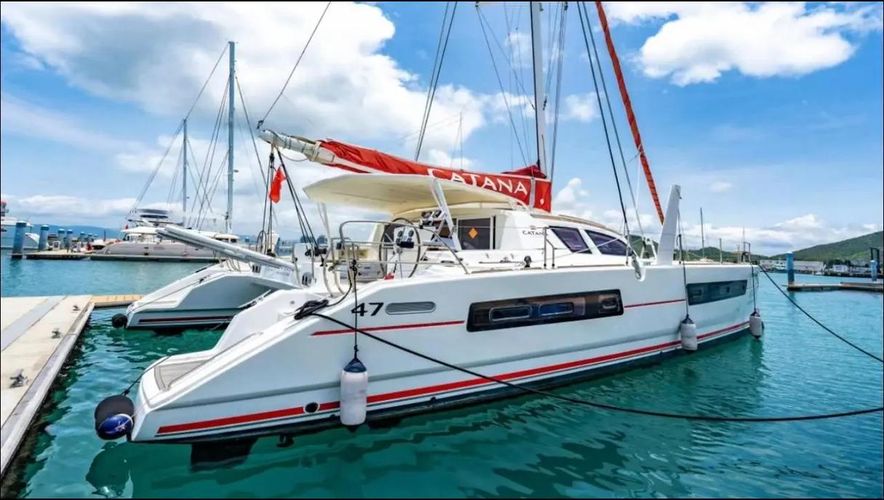
Abstract: This article shares, from the perspective of an ordinary boat owner in Europe or the United States, the pricing pitfalls, hidden costs, and practical nuances encountered when purchasing a catamaran at a marina.From selecting a boat model to negotiation techniques, and from marina mooring fees to common misconceptions about insurance, this article covers aspects that beginners are particularly prone to overlook.The entire article is based on my three years of personal experience, combined with relevant data from the North American Marina Association for 2024 and real-life case studies, to help you avoid the pitfall of “affording the purchase but struggling to maintain it.”
Author’s Note: My name is Mike, and I’m writing from the perspective of an amateur sailor who has lived in Florida for six years. I began the process of purchasing my first used catamaran three years ago, starting completely from scratch.During this time, I’ve encountered repair pitfalls, faced deceptive practices by marinas regarding security deposits, and narrowly avoided significant losses due to insurance policy clauses.Later, I helped three friends successfully find boats, and I’ve had many drinks with local veteran boat owners, discussing all things boating. This article is my candid account of those painful and hard-learned lessons, laid bare without reservation.
Buying a Catamaran? First, Understand the “Marina Price” Trap
If you search for “catamaran sailboat for sale marina price,” well, there’s an 80% chance you’re doing so because you’ve been blinded by promotional ads.
The prices listed on those websites look pretty good. A 1999 Lagoon 380, for example, is priced at $89,000. You do the math in your head: Wow, that’s actually quite a bit below my budget.
Hold on.
That price is called the “asking price”—it’s whatever the seller decides to list. When it actually comes time for you to pay, that number will more than double.
I met a guy at the Miami marina who had his eye on a 2005 Leopard 40 listed at $125,000.He happily put down a deposit, but after doing some digging, he discovered that the dock fees had been in arrears for two years, the engine overhaul records were completely blank, and the hull hadn’t been painted in three years. In the end, it cost him nearly 170,000 to actually take ownership of the boat.
So remember this: the listed price is just bait; the real cost lies in the details.
Dock fees: a money pit that bleeds you dry every month
Many beginners only look at the price of the boat. They think it’s not expensive and that they can afford it.
Wrong.
Dock fees are the real cost.
I used to rent a berth in Fort Lauderdale for a 40-foot catamaran, which cost $850 a month. Do you think that’s the end of it? Wrong—electricity is billed separately, water is billed separately, and sewage fees are billed separately as well. Electricity usage spikes in the summer, and the monthly electricity bill can soar to $200.
Data from the North American Marina Association in 2024 shows that the average monthly fee for marinas along the Florida coast has risen to between $18 and $25 per foot.Do the math: for a 40-foot boat, the monthly cost ranges from $720 to $1,000. That means, over the course of a year, simply keeping the boat moored—without moving it—will cost over $10,000.
On top of that, many marinas require a security deposit, with some demanding three months’ payment in advance and others requiring six months’ payment in advance. When a friend of mine was renting a berth in Key West, the marina required a lump-sum payment for six months’ fees, plus an additional $5,000 as a security deposit—his face instantly turned pale.
Important tip to avoid pitfalls: Before viewing a boat, make sure to ask where it is currently docked and who is responsible for paying the dock fees. If the seller has outstanding dock fees, there’s a high likelihood that you’ll end up having to cover that debt.Some marinas may impound the boat to offset the debt.
The “Age Trap”: Older Boats Are Cheap, but Repairs Can Be a Nightmare
Catamarans are not like cars.
If a car has been driven for ten years and the engine breaks down, you can simply replace it with a new one.But what about a catamaran? Problems with the hull, the mast, the sails, the engine, the electronics, the plumbing system… Any single issue will cost you at least several thousand dollars to fix.
He thought he’d hit the jackpot, having seen the most outrageous examples.There was a British guy who bought a 1990 Prout 45 for just 45,000. However, on the way back to the Mediterranean, the port engine completely broke down—replacing it with a brand-new Yanmar would cost 18,000.Then, once he arrived at the marina, another problem arose: he discovered a leak in the fresh water tank, which would cost 3,000 to repair. On top of that, the sails were in terrible shape, and replacing a full set of Dacron sails would cost 6,000.
In the end, he did the math: the boat cost 45,000, and the repairs came to 35,000. Looking at it that way, it would have been better to just buy a boat in good condition outright.
So my advice is this: when buying a boat, prioritize models from 2005 onward.This is especially true for brands like Lagoon, Leopard, and Fountaine Pajot, as their craftsmanship has improved significantly since 2000. That’s not to say you shouldn’t buy older boats at all, but you’ll need to set aside at least 30 percent of the boat’s purchase price for repairs.
Insurance: Many people forget to factor this into their calculations
You need insurance when buying a boat. Everyone knows that.
But do you know how expensive insurance for catamarans is?
When I renewed my policy in 2023, the insurance company informed me that premiums for catamarans are higher than those for monohulls, with a premium increase ranging from 40% to 60%. Why is that? It’s because catamarans are more prone to capsizing during storms, and the cost of repairs is also higher.
At the time, I was insured with BoatUS. The annual premium was $2,800, with coverage of $300,000 and a deductible of $5,000—and that was the rate for someone with no claims history. For a first-year owner, the premium could rise to $4,000.
Additionally, many insurance companies set age limits on boats. If a boat is over 20 years old, the insurer will either decline coverage or double the premium.My friend’s boat, built in 1998, was flatly refused coverage by the insurance company. After approaching five different companies, he finally found one willing to insure it, with an annual premium of 5,000 yuan.
Therefore, before going to view a boat, be sure to call an insurance company first to inquire whether the boat can be insured and what the approximate premium would be. Don’t wait until after you’ve already purchased the boat to realize you simply can’t afford the premium.
Negotiation Tip: Don’t Let the Seller Lead You by the Nose
There are two types of boat sellers at the marina.

One type is genuinely eager to sell—for reasons such as divorce, relocation, or financial hardship. In these situations, you’ll have more room to negotiate.Last year, I helped a friend negotiate the purchase of a Lagoon 380. The seller’s asking price was 95,000. I checked the boat’s maintenance records and discovered that the engine was making unusual noises, and the sails were showing signs of wear and tear.I told the seller, “80,000, cash payment, and we’ll sign the contract today.” He hesitated for two days but eventually agreed.
There are situations where the seller isn’t in a rush to sell—for example, retired seniors who treat their boats as hobbies and aren’t short on money. In cases like this, it’s very difficult to successfully negotiate a lower price.I once met an elderly man whose boat had been listed on a sales platform for a full two years without any price changes; eventually, a buyer purchased it at the original price.
How can you tell? You need to check the boat’s condition. If the boat is very dirty, the equipment is broken but hasn’t been repaired, and the sails are piled up haphazardly, that indicates the seller doesn’t want to invest any more money and is eager to offload it.If the boat is clean, the equipment is in good working order, and the sails are neatly stowed, it means the seller is actively using the boat and isn’t in a hurry to sell.
Here’s a little tip: ask the seller why they’re selling. If they say “I don’t have time to use it” or “I’m upgrading to a bigger boat,” you can usually negotiate. But if they say, “This boat is in great condition; I just want to trade it in,” you should be extra cautious—they’re most likely just making empty promises.
Q: Which retains its value better—catamarans or monohulls?
Over the past two years, the used catamaran market has seen a fairly significant price increase. From 2021 through 2023, amid the impact of the pandemic, prices for used catamarans rose by approximately 20% to 30%.Although prices have retreated slightly at present, catamarans still generally retain their value better than monohulls. What exactly is the reason behind this? Because catamarans offer more space and are well-suited for family use, they are particularly popular among retirees. While monohulls perform well, their prices in the used market fluctuate significantly. If you plan to sell your boat after a few years of ownership, catamarans offer more stable market performance.
Q: Can marina docking fees be negotiated?
Yes, but it depends on the marina. At popular marinas like Fort Lauderdale and Miami Beach, there’s generally no room for negotiation. At less popular ones, such as Tampa or Jacksonville, you can try to negotiate a discount for annual payment. I have a friend who moors in St. Petersburg and got a 10% discount on the annual fee, but you have to pay for the entire year upfront.
Q: Should I hire a boat inspector when buying a boat?
Absolutely, definitely—you absolutely must. I’ve seen so many people who tried to save those $500 to $800, only to discover major problems after they bought the boat.A surveyor will inspect the hull, the engine, the electronics, the plumbing, the sails, and the mast. They’ll provide you with a detailed report.With this report in hand, you can negotiate a lower price with the seller. The last time I had a boat inspection, I discovered a minor oil leak in the engine, and as a result, I managed to knock 3,000 off the price. The inspection fee was only 600. Is it worth it or not? Do the math yourself.
Q: What’s the first thing you should do after buying a boat?
Don’t rush out to sea just yet. Before you set out, check all safety equipment—such as life jackets, fire extinguishers, flares, and first-aid kits. Then inspect the engine and batteries. After that, drain the freshwater tank completely, refill it, and check for leaks.The first time I bought a boat, I went out to sea the very next day, but the freshwater tank started leaking, and all the water drained out. Being out on the vast ocean with no water to drink—isn’t that a terrible situation?
Q: Are catamarans suitable for beginners?
Yes, they are, but only if you’re willing to invest the time to learn. Catamarans are more stable than monohulls, are less likely to cause seasickness, and offer more space, making them ideal for families. However, operating a catamaran is different from operating a monohull.When docking, catamarans experience greater wind resistance and are easily blown off course. The first time I tried to dock, I nearly collided with the boat next to me. I recommend finding an instructor first, or going out to sea a few times with an experienced friend. Never try to do it on your own without proper guidance.