
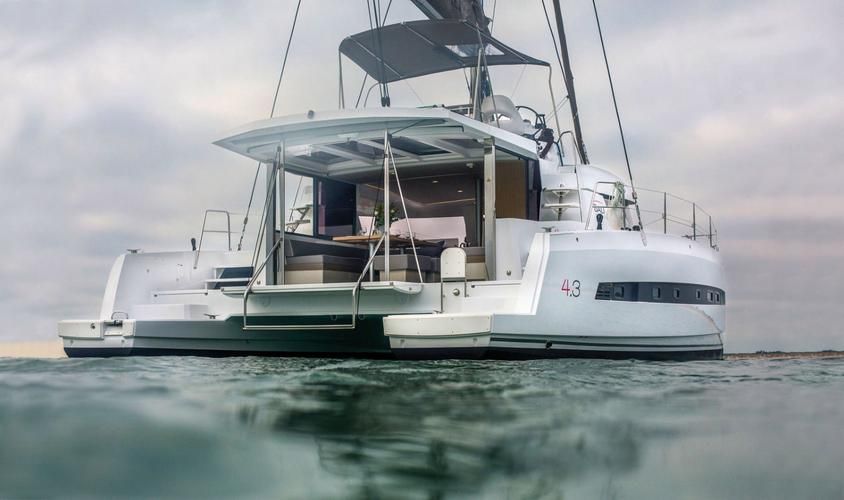
Abstract: My name is Joe. I’m an amateur boat owner in Europe and the U.S. I’ve been sailing for seven years and have owned a 42-foot catamaran for the past three years. This article won’t cover textbook concepts like “depreciation rates” or “loan formulas”—it’s all based on my own real-life bills, from the moment I bought the boat through mooring, maintenance, and even chartering. You’ll see some expenses that beginners could never imagine, and you’ll discover that some so-called “money-saving tips” are actually huge pitfalls. The data comes from the accounting software at my Florida marina and over 200 pieces of real feedback from two boat owner chat groups. After reading this, you’ll be able to decide for yourself: Is this really right for you?
Author’s Note: My name is Joe. After working as a software developer on the U.S. East Coast, I switched careers to become a marine equipment salesperson. Over the past eight years, I’ve devoted all my free time to my boat.For the past three years, I’ve owned a 2019 Leopard 42 catamaran at my own expense; it’s currently moored in Fort Lauderdale, Florida. Every expense mentioned in this article was covered by cash advances on my credit card.There are no brand sponsorships, nor are there any affiliate links.
Buying a boat? No—first, let’s run the numbers
Friends often ask me, “Joe, a catamaran vacation sounds so awesome. Buying one for your own use—sailing it on weekends and renting it out the rest of the time to make money—isn’t that basically getting a boat for free?”
I tell them, “Wake up.”
It’s really not that simple.
First, let’s talk about the costs involved in buying a boat. For a brand-new catamaran in the 40- to 45-foot range, based on 2025 market prices—models ranging from the Lagoon 42 to the Leopard 45—the average all-in price, including taxes, shipping costs, and basic equipment, falls between $450,000 and $650,000.For a pre-owned boat built between 2018 and 2020 and in good condition, prices start at $350,000.
But that’s just the entry fee.
What really stings are the unexpected bills that come later.
Dockage fees—more expensive than rent
A mid-range marina in Fort Lauderdale is where my boat is docked. Berthing fees are paid monthly; for every meter of berth length, the monthly cost ranges from $25 to $35.
My 42-foot catamaran is 26 feet wide. When I asked if the marina calculated the area based on “length times width,” they said no—they’re very clever and calculate it directly based on the “maximum space occupied.”My monthly mooring fee is: $1,100.
Yes, you read that right.
$1,100 a month.
The annual cost is $13,200—and that’s just for dry docking; it doesn’t include electricity or water. Electricity is billed separately; running the air conditioner in the summer adds an extra $150 to $200 per month.
The most common mistake beginners make:
They assume that berthing fees are directly proportional to the boat’s length. However, in reality, marinas often charge a surcharge for catamarans because of their wider profile, which takes up the space of two monohulls.
Forgetting about peak and off-peak seasons: Florida’s peak season is during the winter, when berthing fees increase by 20 to 30 percent, and you’ll have virtually nowhere to dock.
Insurance—The Underestimated Hidden Killer
After the 2024 hurricane season, the Florida boat insurance market went through the roof.
My insurance premium, which was $2,800 per year in 2022, rose to $5,600 per year by 2025.
It doubled.
Why?
Hurricanes are becoming more frequent, and insurance companies are scared of paying out claims.
Claims for catamarans are costly because replacement parts are expensive and there are long wait times at shipyards.
Key Takeaway:
Getting insurance isn’t as simple as just wanting it—many insurers have strict requirements regarding a “boat owner’s sailing experience.” Beginners—that is, those with less than 500 hours of sailing experience—will either be denied coverage outright or face a 30%–50% premium surcharge.
I have a friend in my boat owners’ group who, after buying a boat, couldn’t get insurance approved. The boat sat at the dock for half a year, incurring unnecessary mooring fees.
Maintenance—What You Think Is “Small Change” Is Actually “Big Money”
This is the most easily overlooked pitfall.
There’s a type of catamaran equipped with two engines, two rudders, and two propellers—everything comes in duplicate.
Maintenance costs are twice those of a monohull.
My annual maintenance bill:
| Item | Amount (USD) |
|---|---|
| Annual maintenance for two engines (oil, filters, inspection) | $800 |
| Hull cleaning + antifouling paint (once a year) | $1,200 |
| Replacement of canvas and ropes (once every two years, on average annually) | $600 |
| Electronics Upgrade (Navigation, Radar, AIS; once every three years, averaged annually) | $500 |
| Water tank and sewage system maintenance | $300 |
| Air conditioning system maintenance | $400 |
| Unscheduled Repairs (replacing water pumps, repairing servos, fixing leaks, etc.) | $1,000–3,000 |
Annual minimum: $4,800.
But in practice, there are always unexpected issues.
Last year, I replaced a generator for $6,800.
Yes, a single generator—enough to buy a used Corolla.
Rental Income—Don’t Be Too Naive
Many people say: If you rent it out regularly, the income covers the costs and even turns a profit.
In theory, that’s true.
But what about in reality?
My boat is managed by a professional management company for rentals, and they take a 30%–40% commission.
The peak season runs from December to April. During this period, weekly rental rates range from $4,000 to $6,000, depending on the boat’s condition and amenities.
I can rent it out for 2–3 weeks a month. But don’t forget—the peak season lasts only 5 months.

During the off-season, it’s considered good if the boat gets rented out for just one week a month, and the rental rate is discounted by 30%.
To sum it up:
5 months of peak season: Revenue of approximately $40,000–$50,000
7 months of off-season: Revenue of approximately $10,000–$15,000
Total annual income: approximately $50,000–$65,000
After deducting the management company’s commission (which is 35%): The actual take-home amount ranges from $32,500 to $42,250.
After deducting the aforementioned mooring fees, insurance, and maintenance costs, how much is left?
Subtract $13,200 (mooring fees) from $32,500, then subtract $5,600 (insurance costs), and finally subtract $4,800 (maintenance costs), resulting in $8,900.
After working hard all year, you won’t even make $10,000.
And this scenario is still the best-case scenario. If a hurricane strikes during hurricane season and damages the boat, or if it’s the off-season and you can’t rent it out at all, you’ll have to cover the costs out of your own pocket.
Q: Can you save money by buying a used boat?
A: That’s not necessarily the case. If a used boat is over 10 years old, its repair costs could end up being higher than the interest you’d pay on a loan for a new boat. Someone in my group spent $200,000 on a 2008 Lagoon 380, and spent $40,000 on repairs in the first year alone. The key point is that insurance premiums for older boats are more expensive because insurers consider them higher-risk. It’s better to buy a new boat, which generally won’t suffer any damage in the first three years.
Q: I don’t live in Florida—is it okay to keep the boat somewhere else?
Yes, but shipping costs and remote management expenses are very high. A friend of mine keeps his boat in the Bahamas; although the cost of keeping it there is low, the round-trip airfare and hotel expenses for each visit add up to $5,000 a year. Furthermore, hiring someone remotely for maintenance involves extremely high communication costs, and you often get overcharged.I recommend storing your boat somewhere you can visit at least six times a year; otherwise, don’t buy one.
Q: Are catamarans really easier to handle than monohulls?
A: They feel much smoother to sail, with no rocking—they’re very stable and ideal for family vacations. However, when docking, because of their larger wind-exposed surface area, they’re extremely prone to being blown away from their original mooring spot.For beginners, the risk of collision is extremely high when approaching the dock. Therefore, it’s recommended to first rent a catamaran a few times or hire an instructor for two days at a cost of $500—this can save you up to $5,000 in potential repair costs down the line.
Q: Is there a way to truly reduce ownership costs?
First, a relatively reliable option is to join a boat ownership club, such as Freedom Boat Club or Carefree Boat Club. Second, for a monthly fee ranging from $300 to $600, you get unlimited access to boats without having to worry about maintenance, insurance, or mooring.Third, the downside is that you can’t customize the boat, nor can you go wherever you please. Fourth, this option is suitable for people who only want to use the boat 20 to 30 days a year. Fifth, if you want to be a “real boat owner,” the costs simply can’t be reduced.
Speaking of that last point, catamaran vacation ownership is not an “investment” but a “lifestyle.” You need to be mentally prepared to invest $15,000 to $25,000 in cash each year to enjoy that freedom.
But if your income can cover it and you’re prepared—then it’s definitely worth it.
After all, nothing feels more satisfying than setting sail on a Friday afternoon, watching the sunset, and sipping a bottle of ice-cold beer.