
Catamarans are conquering the hearts of sailors worldwide at an unprecedented pace. From family cruising to offshore racing, these twin‑hulled platforms are redefining the boundaries of modern sailing with their unparalleled stability, expansive living space and thrilling speed potential. Yet the very “non‑heeling” nature of a catamaran is a double‑edged sword – it will not spill excess wind pressure by heeling like a monohull. Instead, it faithfully converts every gust into hull load and boat speed, which can rapidly escalate into disaster if unchecked. Veteran skipper Mike Kopman perfectly captured this core paradox: “When a gust hits a monohull you instantly know – she heels, spills wind, and may round up. But on a catamaran with massive righting moment, the structure absorbs all the extra load. There is no heeling cue, no automatic depowering mechanism.” It is precisely this characteristic that demands a completely different technical system and judgement logic.
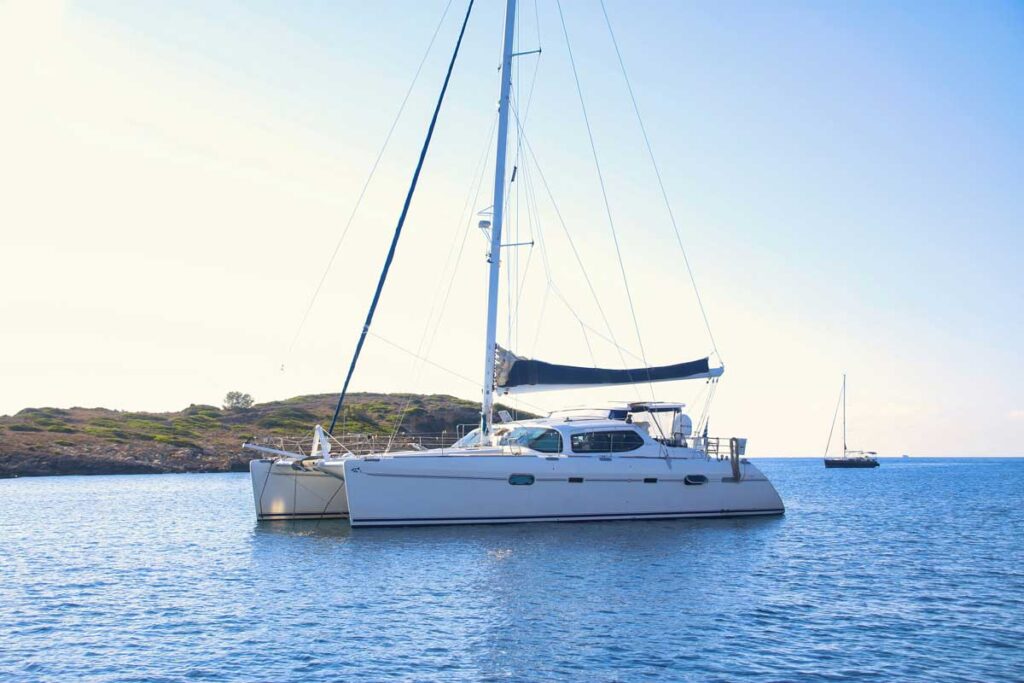
1. Sail Trim: Traveller, Twist & the Code Zero Revolution
Sail trim is the first lesson in catamaran performance optimisation. The wide beam gives these boats an exceptionally long traveller, which fundamentally alters mainsail control. As Sam Newton of Rolly Tasker Sails explains: on a cat the boom’s lateral position is governed primarily by the traveller; the mainsheet mainly controls leech tension – that is, twist – and a vang is often absent. The industry consensus runs deep: traveller controls position, mainsheet controls shape.
| Wind Speed (True) | Traveller Position | Mainsheet Tension | Headsail Sheet Lead | Target AWA |
|---|---|---|---|---|
| 0–8 kn | 30–50 cm to windward | Eased (visible twist 15–20°) | Full forward, telltales breaking evenly | 45–50° |
| 8–14 kn | Centered to 10 cm leeward | Moderate (twist 10–12°) | Slightly aft; momentum mode | 40–45° |
| 14–20 kn | 20–40 cm to leeward | Firm (upper telltales lifting 50 %) | Car moved aft 2–3 holes; backstay tension ON | 38–42° |
| 20–28 kn | 50–70 cm to leeward | Very firm (twist <5°, top batten parallel to boom) | Lead fully aft; consider blade jib | 35–38° |
Scenario Tip: In light air (0‑12 kn) keep the traveller slightly to windward and the mainsheet eased so the top batten points 15‑20° outboard. As the breeze builds to 18+ knots, progressively drop the traveller to leeward – this feathers the upper third of the main, shedding heeling moment while keeping the lower section driving.
2. Centerboards vs. Daggerboards: Geometry, Safety & Performance
The choice between a pivoting centerboard and a vertical daggerboard is a core technical fork. Collin Marshall of Kinetic Catamarans details that a centerboard’s greatest asset is its built‑in “fuse” – a shear‑pin mechanism that allows the board to kick up on impact, minimising structural damage. A daggerboard, meanwhile, offers pure performance: it can be moulded with an asymmetric, even curved foil section to generate additional lift to windward, but grounding transmits the full impact through the bearing box.
| AWA / Condition | Windward Board | Leeward Board | Boat Speed Gain |
|---|---|---|---|
| 30–50° (light) | Fully retracted | Fully down | +0.4 kn vs. both down |
| 50–80° (moderate) | 25–50 % down | Fully down | Reduces leeway 4–6° |
| 80–120° (reaching) | Retracted | 30–50 % down | Lowers drag ~12 % |
| 120–180° (downwind) | Both fully retracted | n/a | Drag reduction up to 18 % |
Scenario Tip: Planning a Bahamas cruise where 1.5 m shoals are the norm? The fuse‑protected centerboard is your safety net. But in a transatlantic race, the extra lift from a cambered daggerboard can be the difference between podium and pack – choose your weapon accordingly.
3. The Reefing Rhythm: Wind Speed, Sea State & Sail Plan
Maritime lore insists “reef when you first think about it.” On a catamaran, that adage carries ten times the weight. Standard industry practice paints a clear gradient: first reef at about 18 kn apparent, second at 24 kn, third at 30 kn. But a single number is never enough – sea state, angle of attack, and gust stability all reshape the real‑world need.
| Apparent Wind (kn) | Main Reef | Headsail Area | Target Speed (kn) | Remarks |
|---|---|---|---|---|
| 0–16 | Full | 100 % genoa | 6.5–8.5 | Code 0 usable 90–160° AWA |
| 16–22 | Reef 1 | 100 % genoa | 7.5–9.0 | Move traveller down |
| 22–28 | Reef 2 | Reduce to 75 % (or staysail) | 7.0–8.5 | Reef before crew gets nervous |
| 28–34 | Reef 3 | Staysail only or furled | 5.5–7.0 | Survival mode begins |
| >34–45 | Reef 3 or trysail | None or storm jib | 4.0–5.5 | Deploy sea anchor if beam sea |
Scenario Tip: Upwind always demands earlier reefing than downwind. Apparent wind is higher, and the forward hull often loads up before the rig complains. The XCS Excess 15 manual, for example, calls for Reef 1 at 23 kn apparent when beating, but the same reef can be delayed to 28 kn apparent on a broad reach.
4. Heavy‑Weather Tactics: Sea Anchors, Skeg Rudders & Survival Trim
Once the wind tops 35 knots and the sea state deteriorates, the operational logic flips to survival mode. The priority is maintaining steerage and a moderate speed, not pursuing a course. Turning head‑to‑wind early reduces capsize risk; drastically reducing canvas early keeps the boat manageable. The sea anchor then becomes the single most strategic tool – it does not stop the boat, but creates a pivot point that holds the bows to the weather, dramatically lowering the chance of a beam‑sea knockdown.
| Device | Diameter / Parachute | Rode Length (water depth ×) | Boat Speed in 50 kn | Typical Yaw Angle |
|---|---|---|---|---|
| Para‑Tech sea anchor | 18 ft (5.5 m) | 10–12× | 0.8–1.5 kn | ±12° |
| Gale Rider drogue | 36 in (91 cm) cone | 5–6× (from stern) | 3.5–5 kn | ±25° |
| Series drogue (JSD) | 120+ cones on 150 m line | Deployed from stern | 2.0–3.5 kn | ±15° |
Scenario Tip: High‑performance cruising cats like the Antares feature skeg‑hung rudders that track like rails when surfing downhill, keeping the boat controllable in 50‑kn gusts. But production “floating home” designs have far smaller safety margins – don’t confuse design limits with universal safety. When in doubt, deploy a sea anchor early; it is far easier to retrieve a sea anchor in moderating conditions than to recover from a knock‑down.
5. Capsize Prevention & Recovery: Myths, Reality & Survival Protocols
Capsize is the ultimate nightmare of catamaran sailing, yet the discussion is surrounded by misconceptions. Standard production catamarans – those “floating homes” built for comfort – are statistically very difficult to capsize because their deck gear is deliberately downsized, limiting the crew’s ability to overdrive the boat. The real risk is therefore determined far more by the skipper’s judgement than by the hull form.
| Risk Factor | Threshold / Indicator | Mitigation |
|---|---|---|
| Apparent wind vs. righting moment | Load cells on shrouds exceed 85 % of MBL | Immediate reef or head up |
| Wave face steepness | Wave height >55 % of waterline length | Avoid beam‑on drift; adjust course |
| Mainsheet failure to ease | Traveller car jamming | Install open‑back traveller; carry axe |
| Night‑time squall | Sudden 15+ kn increase | Pre‑set reef for overnight conditions |
Scenario Tip: If an inversion is unavoidable, crew below deck must immediately move to one hull and away from the bridgedeck – which will become the first part to submerge. For overnight passages in heavy weather, assign bunks in the outer hulls rather than the central saloon, giving every crew member the fastest possible escape route. And never open the escape hatch prematurely; once seawater pours in, it can drag the boat into a full turtle.
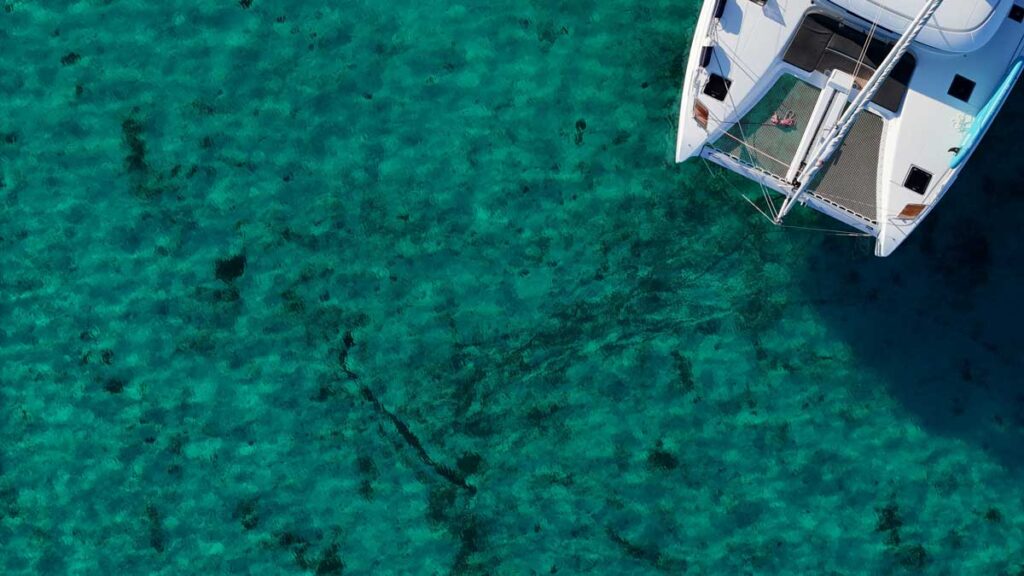
6. Anchoring & Mooring: The Bridle, the Dance & Mediterranean Moor
A catamaran at anchor behaves fundamentally differently to a monohull. Without intervention, she will “dance” around the anchor – sheering off to one side, sailing out at ~45°, being hauled back by the chain, crossing the eye of the wind, and repeating the cycle on the other tack. This not only chews up swing room but also shatters the nerves of neighbouring crews.
| Configuration | Swing Radius (scope 5:1, 10 m depth) | Max Sheer Angle | Recommended Conditions |
|---|---|---|---|
| Single chain, no bridle | 65–70 m | ±55° | Never recommended |
| Single bridle (standard 2‑point) | 55 m | ±20° | 5–25 kn, open roadstead |
| Bridle + riding chain weight | 52 m | ±12° | 20–40 kn, moderate chop |
| Mediterranean moor (bow anchor + stern lines) | 0 m (fixed position) | ±5° | Crowded harbours, quay‑to‑quay |
Scenario Tip: The anchor bridle is the sole authentic remedy for catamaran “anchor dance.” By splitting the load to the two bows, it automatically increases tension on the windward leg when the boat sheers, pulling the bows back. Always approach the anchorage from downwind, use twin engines to hold station, and once the anchor is set, reverse both engines to 2000 rpm for 30 seconds to confirm the anchor is buried.
7. Man Overboard (MOB): High Freeboard, Windage & Recovery Systems
On a cat, MOB recovery presents unique challenges. The light displacement and large windage mean the boat drifts faster than a monohull at idle speed, and the high freeboard creates substantial blind zones. Professional crews routinely equip key stations – helm, bow, winch, navigator – with wireless headsets, enabling seamless coordination without shouting.
| Method | Time to First Contact | Boat Drift (m/min) | Success Rate (drill, moderate sea) |
|---|---|---|---|
| Quick‑stop (crash tack) | 55–70 s | 18 m/min | ~72 % |
| Figure‑eight (power) | 90–120 s | 28 m/min | ~65 % |
| Lifesling & dedicated recovery line | 120–150 s | n/a (boat circles victim) | ~89 % |
| Compact davit‑launched inflatable raft | 180 s | n/a | ~95 % (simulated) |
Scenario Tip: The standard technique is to approach on a close‑reaching course, luffing to depower and reducing speed to less than 2 kn. Because of the high freeboard, a rigid‑pole boat hook or dedicated Lifesling is mandatory – pulling a soaked adult in foul‑weather gear up 1.5 m of topsides requires mechanical advantage. Fit every lifejacket with an AIS MOB device; within 60 seconds of immersion it will transmit the victim’s GPS position to the vessel’s MFD and all AIS‑equipped stations in range.
8. Racing Strategy: Polars, Gust Lanes & the Two‑Step Ahead Rule
World‑record‑holding skipper Helena Darvelid, after 11,000 nm aboard Allegra, distilled racing multihull philosophy into one sentence: Always stay two to three steps ahead. On the starting line that means building speed gradually so that the boat “slides” into the start window with full pace one minute before the gun, ensuring a clean lane and zero blanketing.
| Decision | Avg Speed Gain (kn) | Distance Saved (24‑h period) | Risk Level |
|---|---|---|---|
| Pre‑start acceleration box | +0.8 (first 5 min) | – | Low |
| Following a gust lane (cloud‑line) | +1.2–1.8 | 4–7 nm gained in 3 h | Medium |
| Gybing on a 5° header vs. 10° | +0.3 avg over leg | 2.5 nm per 100 nm leg | Low |
| Offshore route optimised by PredictWind VPP | +0.9–1.4 | 20–40 nm over 5‑day passage | Low (if models agree) |
Scenario Tip: The cruising sailor can steal one vital lesson from the racing world: before a squall hits, every crew member must know the pre‑agreed escape plan. Will you feather up into the gust or bear away and accelerate out? Decide before you are in the claw of the storm, because in the moment there is no time to debate.
9. Crew Coordination & Communication: The Three‑Beat Loop
Professional coach Nikki Henderson sums it up: “On a boat, communication is the single most important factor shaping the crew’s experience. Good comms keep people safe, make manoeuvres smooth, and foster a positive atmosphere. Poor comms can push someone to breaking point in minutes, creating chaos and eroding safety.”
| Protocol | Manouevre Time (reduction vs. baseline) | Error Rate (drill assessments) | Best Use |
|---|---|---|---|
| Open loop (no repeat) | Baseline | ~22 % | Casual day sail |
| Closed loop (repeat‑back) | –8 % | ~11 % | Night watches, reduced crew |
| Three‑beat (Command – Repeat – Confirm) | –15 % | ~5 % | Sail changes, squall prep, MOB |
| Headset plus three‑beat | –22 % | ~3 % | Blind‑spot operations, anchoring |
Scenario Tip: The flybridge of a catamaran physically isolates the helm from the foredeck. Use the three‑beat loop – Command, Repeat, Confirm – over a dedicated wireless headset channel. For critical evolutions such as reefing in a squall, the foredeck crew repeats the command (“Ease halyard 2 m”) before acting, and the helm confirms when the action is seen on instruments.
10. Route Planning & Weather Intelligence: Polars, GRIBs & VPP
Modern catamaran navigation has entered a data‑driven era. Raymarine’s integrated polar diagrams for Leopard catamarans condense the theoretical maximum speed at every true wind speed and angle into a precision curve set, displayed live on the chartplotter. The Velocity Prediction Program (VPP) behind those polars merges hull weight, lines, sail plan and appendages into an iteratively optimised mathematical model.
| Weather Model | Resolution | Update Cycle | Best Use Case | Catamaran‑Specific Note |
|---|---|---|---|---|
| ECMWF (Euro) | 9 km | 6 h | Offshore 3–7 days | Under‑predicts gusts in convergence zones |
| GFS (NOAA) | 13 km | 6 h | Global overview | Smooths tropical squall peaks |
| ICON (DWD) | 6.5 km | 3 h | European waters 1–3 days | Excellent for Med summer thermals |
| PredictWind PWG & PWE | 1 km / 8 km | 1 h / 3 h | Coastal & race routing | Integrates custom catamaran polars |
Scenario Tip: When planning a trans‑oceanic passage, feed your vessel’s custom polar data, maximum acceptable wave height (e.g. 4 m) and minimum motoring wind speed into the routing algorithm. PredictWind’s engine will then compute three optimised routes – fastest, safest and least fuel – within seconds, allowing you to actively circumnavigate a developing storm rather than passively endure it.
Conclusion: The Art of Anticipation
Catamaran sailing is a rigorous technical discipline, not a collection of intuitive hunches. From every micro‑adjustment of the traveller to the life‑or‑death timing of a reef, every link in the chain requires the skipper to possess a deep cognitive grasp of hull physics, aerodynamics and meteorology. The finest multihull sailor is not the fastest mover, but the most accurate judge. On a stable, non‑heeling deck, in moments that appear utterly serene, maintaining a continuous evaluation of wind, load and sea state – this “prescient judgement” is the highest art of catamaran seamanship. It is the core skill that every data set and technique in this guide strives to cultivate.